SECTION 8.4
pH and hormonal control of urine
Explain how the kidneys help regulate blood pH and how hormones change the volume and composition of urine.
Learn
Blood pH must stay within a narrow range, about 7.35 to 7.45, because the shape and activity of almost every protein depend on it. Three systems keep it there: chemical buffers, which act within seconds; the lungs, which adjust carbon dioxide within minutes; and the kidneys, which take hours or days but provide the definitive correction by adjusting bicarbonate and hydrogen ions. The kidney does this in two connected ways: it reclaims the bicarbonate that is filtered, so it is not lost in urine, and it secretes hydrogen ions into the tubular fluid, where they are buffered and excreted. At the same time, hormones such as ADH, aldosterone and parathyroid hormone change how much water, sodium, potassium, calcium and phosphate leave the body, so the composition of urine reflects the state of the whole body. This section explains acid handling and hormonal control of urine.
Key Concepts & Topics
Why blood pH must stay stable
pH is a measure of hydrogen ion concentration: a lower pH means more hydrogen ions and a more acidic solution. Blood normally sits in a very narrow range, about 7.35 to 7.45, and even small departures change the shape of proteins and the rate of enzyme reactions. Acid is produced continuously by metabolism, mainly as carbon dioxide and as non-volatile acids from proteins and fats, so it must be removed continuously. Three lines of defence operate on different timescales. Chemical buffers in blood and cells combine with hydrogen ions immediately. The lungs remove carbon dioxide, and by changing breathing rate they adjust acid within minutes. The kidneys excrete hydrogen ions and manage bicarbonate, which takes hours to days but restores the actual amount of acid and base in the body.
For example: In severe vomiting, loss of stomach acid can raise blood pH above normal, producing a metabolic alkalosis.
How the kidney handles acid
The kidney controls acid by handling bicarbonate and hydrogen ions together. Filtered bicarbonate would be lost in the urine if nothing were done, so tubule cells reclaim almost all of it: hydrogen ions are secreted into the tubular fluid, combine with bicarbonate there, and the resulting carbon dioxide enters the cell and is converted back into bicarbonate, which returns to the blood. Secreted hydrogen ions that are not used for reclaiming bicarbonate must be excreted, and because free hydrogen ions would make urine extremely acidic, they are buffered in the tubular fluid, mainly by phosphate and by ammonia. Ammonia produced by tubule cells combines with hydrogen ions to form ammonium, which is trapped in the urine and excreted. Each hydrogen ion excreted in this way generates a new bicarbonate ion for the blood, so the kidney can both remove acid and replenish the body’s base.
For example: Urine is normally slightly acidic because the kidneys excrete the acid produced by metabolism, and its pH can vary from about 4.5 to 8 depending on diet and body state.
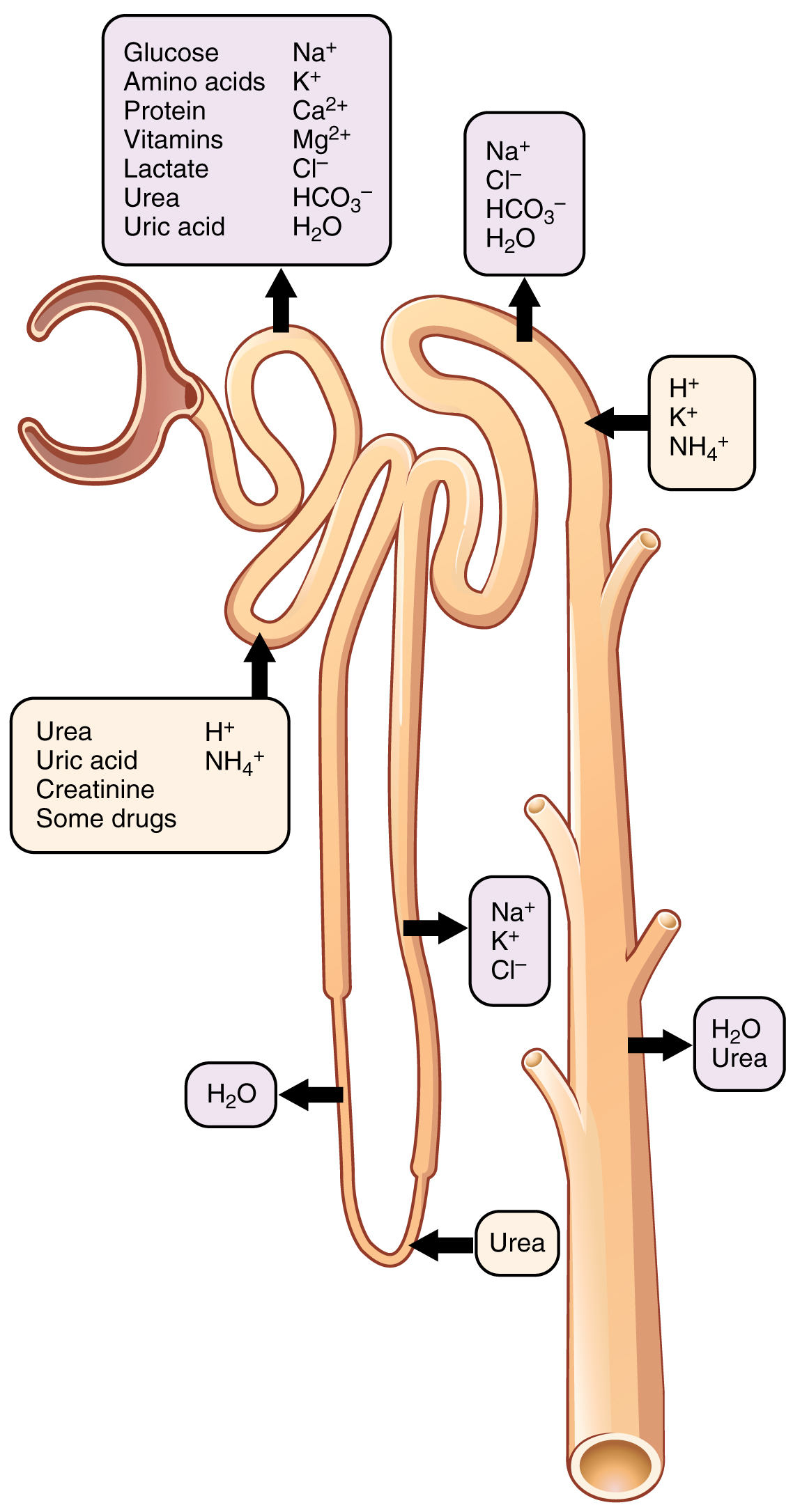 Enlarge illustration ↗
Read each arrow relative to the tubule. Outward arrows show reabsorption toward the surrounding tissue and blood; inward arrows show secretion into tubular fluid. Find the H⁺ arrows: adding hydrogen ions to the tubular fluid helps remove acid from the body.
Image source and licence
OpenStax College · Source image · CC BY 3.0. Original image, reproduced without alteration.
Respiratory and metabolic acid–base problems
Acid–base disorders are described by which system is primarily responsible. If breathing is inadequate, carbon dioxide accumulates and pH falls: this is respiratory acidosis. If breathing is excessive, carbon dioxide is blown off and pH rises: respiratory alkalosis. If the primary problem is not carbon dioxide but the amount of bicarbonate or fixed acid, the disorder is metabolic: metabolic acidosis occurs when acids accumulate or bicarbonate is lost, as in diabetic ketoacidosis or severe diarrhoea, and metabolic alkalosis occurs when acid is lost or bicarbonate accumulates. The body then compensates: the lungs adjust carbon dioxide within minutes and the kidneys adjust bicarbonate over hours to days. Because the kidneys are slower but able to excrete or generate bicarbonate, they provide the definitive correction, and a failure of renal acid excretion causes a persistent metabolic acidosis.
For example: In diabetic ketoacidosis, ketone bodies add acid to the blood, the breathing rate rises to blow off carbon dioxide, and the kidneys try to excrete the excess acid.
Hormones and the composition of urine
Hormones determine what the urine contains. ADH controls water reabsorption in the collecting ducts, so it sets urine volume and concentration. Aldosterone controls sodium reabsorption and potassium secretion in the distal nephron, so it sets sodium retention, potassium loss and, indirectly, blood volume. Atrial natriuretic peptide works in the opposite direction, promoting sodium and water excretion when blood volume is high. Parathyroid hormone acts mainly on calcium and phosphate: it increases calcium reabsorption and reduces phosphate reabsorption, so it raises blood calcium and increases phosphate loss in urine. Other hormones, including cortisol and thyroid hormones, also influence renal handling of salt and water. Because each hormone acts on a specific transporter in a specific nephron segment, the composition of a urine sample can reveal which hormonal signals are active.
For example: A patient with an overactive parathyroid gland loses excessive phosphate in the urine and may have raised blood calcium.
Reading urine as a window on the body
Because urine is the end product of filtration, reabsorption and secretion, its composition is a summary of many processes. Volume indicates water balance, and therefore ADH activity. pH indicates how much acid the kidneys are excreting, and it is affected by diet, by metabolic state and by renal function. Glucose indicates that the reabsorptive transport maximum was exceeded, as in diabetes. Protein or blood indicates damage to the filtration barrier. Ketones indicate that the body is burning fat rapidly, as in uncontrolled diabetes or prolonged fasting. Very dilute urine can indicate that ADH is absent or ineffective, while very concentrated urine suggests water conservation. Clinicians read urine with this logic in mind, and it is why a simple urine test can point toward a diagnosis before more complex investigations are ordered.
For example: A urine dipstick that is positive for ketones in a patient with high blood glucose suggests diabetic ketoacidosis and prompts urgent treatment.
Key facts to remember
- Blood pH is normally 7.35–7.45 and is defended by chemical buffers, the lungs and the kidneys acting on different timescales.
- The kidney reclaims almost all filtered bicarbonate and secretes hydrogen ions, which are buffered in urine mainly by phosphate and ammonia.
- Respiratory disorders involve carbon dioxide; metabolic disorders involve bicarbonate or fixed acid; the kidneys provide the slower, definitive correction.
- ADH sets urine volume and concentration, aldosterone sets sodium retention and potassium loss, ANP opposes them, and parathyroid hormone controls calcium and phosphate.
- Urine pH varies from about 4.5 to 8, and glucose, protein, blood or ketones in urine each point to a specific physiological problem.
Example · Follow the response to metabolic acidosis. Extra acid enters the blood, so pH falls and buffers take up hydrogen ions. Breathing deepens to blow off carbon dioxide, which raises pH a little in minutes. In the tubules, cells secrete more hydrogen ions into the fluid, where they are buffered by phosphate and ammonia and excreted as ammonium. Each hydrogen ion excreted generates a new bicarbonate ion for the blood, so the base deficit is corrected. Urine becomes more acidic as the kidney removes the excess acid. The lungs acted fast, the kidneys corrected the underlying balance.
Read full notes
Read one topic at a time. These notes explain the mechanisms and relationships behind the key facts.
Why blood pH must stay stable
The narrow range of blood pH exists because proteins are sensitive to hydrogen ion concentration. Enzymes, transporters and structural proteins all depend on weak chemical interactions that hydrogen ions can disrupt, so a shift in pH changes their shape and their function. Even a change of 0.1 units can alter enzyme activity measurably, and larger changes can be life-threatening. Because metabolism produces acid continuously, the body must remove it continuously, and it uses three systems with different speeds. Buffers act instantly but are limited in capacity; the lungs act within minutes but only on carbon dioxide; the kidneys act slowly but can excrete fixed acid and adjust bicarbonate, so they determine the long-term balance.
How the kidney handles acid
Renal acid handling is best understood as two linked transactions. The first transaction is bicarbonate recovery: filtered bicarbonate is not simply allowed to pass out, because losing it would remove the body's main buffer. Instead, hydrogen ions are secreted to meet it, and the bicarbonate is returned to the blood. The second transaction is acid excretion: hydrogen ions that are not needed for recovery must leave the body, and they do so buffered by phosphate or ammonia. The two transactions are linked because excreting a buffered hydrogen ion generates a new bicarbonate ion for the blood. This means the kidney can correct a base deficit as well as remove acid, and it explains why renal failure causes acidosis: without working tubules, hydrogen ions accumulate and bicarbonate is lost.
Respiratory and metabolic disorders
Classifying acid–base disorders by their primary cause makes treatment logical. If the problem is carbon dioxide, the fix is to improve ventilation, whether by treating lung disease, removing an obstruction or adjusting a ventilator. If the problem is metabolic, the fix depends on the cause: insulin and fluids for ketoacidosis, replacement of bicarbonate or treatment of diarrhoea, or correction of the underlying disease. In both cases, the other system compensates, which is why a patient's breathing pattern can be a clue to a metabolic problem and why blood results show changes in both carbon dioxide and bicarbonate. The kidneys' slow but definitive role is why chronic kidney disease is so often accompanied by a persistent metabolic acidosis.
Hormones and the composition of urine
Hormones give the kidney its flexibility. The same nephron can produce a large volume of dilute urine or a small volume of concentrated urine depending on ADH; it can retain sodium or excrete it depending on aldosterone and ANP; and it can conserve or waste calcium and phosphate depending on parathyroid hormone. Because each hormone acts on defined transporters in defined segments, the composition of urine is a readout of hormonal activity. This is why urine tests are informative and why hormone disorders so often present with changes in urine volume or composition. It also explains why treating such disorders requires understanding which segment and which transporter is affected.
Reading urine as a window on the body
Urine analysis is powerful because it is non-invasive and because each abnormality has a limited set of explanations. Volume and concentration reflect ADH; pH reflects acid excretion and diet; glucose reflects the transport maximum; protein and blood reflect the filtration barrier; ketones reflect fat metabolism; and the presence of cells or casts can reflect infection or tubular damage. None of these findings is a diagnosis on its own, but each narrows the possibilities. Reading urine in this way links the physiology of filtration, reabsorption, secretion and hormonal control to everyday clinical practice, and it is why the kidney is often described as the body's most informative organ.
Explore the diagram
Start with the whole view, then select a numbered structure. Compare the additional illustrations to connect what a structure looks like with what it does.
A tubule exchanges with blood
Enlarged transport schematic, not one specific tubular segment. Follow arrowheads: reabsorption is toward blood, secretion toward urine. Different transporters act in different nephron regions.
Tubular fluid contains the substances that remain for excretion. Urine volume and composition change as transport occurs along the nephron.
Connect the illustrations to the key ideas
BUFFERS AND THE LUNGS · immediate buffering; carbon dioxide removal in minutes
Buffers limit the pH change; breathing adjusts volatile acid.
THE KIDNEY AND ACID · reclaim bicarbonate; secrete hydrogen ions
Excreted hydrogen ions are buffered by phosphate and ammonia, generating new bicarbonate.
HORMONES AND URINE · ADH, aldosterone, ANP, parathyroid hormone
Each hormone sets a specific component of urine volume and composition.
Core Concepts Defined
- pH
- A measure of hydrogen ion concentration; lower values are more acidic.
- Buffer
- A substance that limits pH change by taking up or releasing hydrogen ions.
- Bicarbonate
- The main base buffer of blood, reclaimed by the kidney.
- Hydrogen ion secretion
- The movement of hydrogen ions from tubule cells into the tubular fluid to remove acid.
- Ammonium
- The ion formed when ammonia combines with hydrogen ions, trapped in urine and excreted.
- Phosphate buffer
- A buffer in tubular fluid that carries excreted hydrogen ions in urine.
- Respiratory acidosis
- A fall in pH caused by inadequate removal of carbon dioxide.
- Respiratory alkalosis
- A rise in pH caused by excessive removal of carbon dioxide.
- Metabolic acidosis
- A fall in pH caused by accumulation of fixed acid or loss of bicarbonate.
- Metabolic alkalosis
- A rise in pH caused by loss of acid or accumulation of bicarbonate.
- Compensation
- The adjustment of the respiratory or renal system that limits the pH change of a primary disorder.
- Renal tubular acidosis
- A condition in which the tubules fail to excrete hydrogen ions or reclaim bicarbonate, causing persistent acidosis.
- Parathyroid hormone
- A hormone that raises blood calcium and increases phosphate loss by the kidney.
- Ketone bodies
- Acidic products of rapid fat breakdown that appear in blood and urine.
- Diuretic
- A substance or drug that increases urine production.
Go deeper · worked example
How the kidney corrects a metabolic acidosis
- Acid is added or bicarbonate lost. Extra hydrogen ions enter the blood or bicarbonate is removed, so pH falls below 7.35 and buffers take up the excess hydrogen ions.
- The lungs respond within minutes. Breathing deepens and quickens, blowing off carbon dioxide, which removes acid and raises pH towards normal.
- The kidney increases hydrogen ion secretion. Tubule cells secrete more hydrogen ions into the fluid. Those used to reclaim bicarbonate return it to the blood, so filtered bicarbonate is not lost.
- Excess hydrogen ions are buffered and excreted. Hydrogen ions not used for bicarbonate are buffered by phosphate and by ammonia forming ammonium, and leave in the urine instead of making it dangerously acidic.
- New bicarbonate is generated. Each hydrogen ion excreted with a buffer produces a new bicarbonate ion that returns to the blood, so the base deficit is corrected and pH is restored over hours to days.
Explain it yourself · Explain why the kidneys are needed for acid–base balance even though the lungs can change pH within minutes.
Reveal a model explanation
The lungs can only remove carbon dioxide, which is volatile acid. Metabolism also produces non-volatile acids from proteins and fats, and these cannot be breathed out. Only the kidneys can excrete them by secreting hydrogen ions into the tubular fluid and eliminating them in urine, buffered by phosphate and ammonia. The kidneys also manage bicarbonate, the body's main base buffer: they reclaim almost all filtered bicarbonate so it is not lost, and they generate new bicarbonate whenever they excrete a hydrogen ion with a buffer. This means the kidneys can both remove acid and replace base, correcting the underlying balance, whereas the lungs can only adjust carbon dioxide temporarily. The lungs provide a fast partial correction; the kidneys provide the definitive one.
Check
Answer three questions from this section — one easy, one medium and one hard. If you miss one, you get a fresh set with explanations for the last attempt.
Practise this sectionOpen all questions and filter by difficulty or Bloom levelReferences and review status
OpenStax, Anatomy and Physiology 2e, 26.4 Acid-Base Balance and 25.9 Regulation of Fluid Volume and Composition; Tortora & Derrickson, Principles of Anatomy and Physiology, 12e, ch. 27. Author review only; medical and French-language expert review pending.
Original teaching schematics. English and French wording is author-reviewed for study; anatomy and French-language expert review is pending. Checks are practice only, not a graded examination.
Practice progress is saved on this device for the current learner.