SECTION 1.2
Levels of organisation
Order the levels of organisation from atoms to the whole organism and explain what changes at each level.
Learn
Your body is organised into levels, and each level is built from the one below it. Atoms join to form molecules. Molecules assemble into the structures of a cell. Similar cells cooperate as a tissue. Tissues combine into an organ, organs cooperate in an organ system, and all the systems together form one organism — you. The levels are not just a list to memorise. At every step the arrangement creates abilities that the parts below do not have on their own. A single muscle cell can shorten; a whole stomach can store, mix and begin to digest a meal. This idea — that the whole can do more than its separate parts — is why health professionals study the body at several levels at once.
Key Concepts & Topics
The chemical level: atoms and molecules
The chemical level is the simplest. An atom is the smallest unit of an element, a pure substance made of one kind of atom. Examples in the body include carbon, hydrogen, oxygen, nitrogen, calcium and potassium. Atoms join by chemical bonds to form a molecule. Small molecules include water and oxygen gas; larger ones are called macromolecules, such as proteins, carbohydrates, lipids and nucleic acids. Each molecule has a shape, and that shape determines what it can do. Haemoglobin, for example, is a large protein whose shape lets it bind oxygen. You do not need to master chemistry to study anatomy, but the chemical level explains why the body needs water, minerals and nutrients.
For example: A water molecule is two hydrogen atoms bonded to one oxygen atom. The same three kinds of atom arranged differently would give a different substance with different behaviour.
The cellular level
The cell is the smallest unit that can carry out all the basic activities of life, including using energy, responding to its surroundings and, in many cases, dividing. A cell is not a simple bag: inside it are organelles, small internal structures each with a job. The nucleus holds most of the cell’s genetic material; mitochondria release usable energy from nutrients; the cell membrane controls what enters and leaves. Cells that will do different jobs become specialised in a process called differentiation. A nerve cell develops long extensions to carry signals, while a muscle cell fills with contractile proteins. Once differentiated, a cell’s structure matches its task — the complementarity principle met again at a new level.
For example: A red blood cell differentiates by losing its nucleus and packing in haemoglobin, which leaves more room to carry oxygen.
Common misconception: Differentiation is not the same as damage. A specialised cell has changed which of its genes are active, not lost the ability to function.
The tissue level
A tissue is a group of similar cells, and the material around them, working together for a common function. The body has four main tissue families: epithelial tissue, which covers and lines surfaces and forms glands; connective tissue, which supports, binds, protects and transports; muscle tissue, which produces movement; and nervous tissue, which carries and processes information. An organ usually contains several tissue types, because a complex job needs more than one kind of cell. The stomach wall is a clear example: epithelium lines and secretes, muscle mixes, connective tissue holds the layers together, and nervous tissue controls the activity. Recognising tissues lets you reason about what an organ can do and what goes wrong when a tissue is injured.
For example: Scar tissue after a deep cut is mostly collagen-producing connective tissue, which is strong but cannot contract or carry signals like the tissue it replaced.
 Enlarge illustration ↗
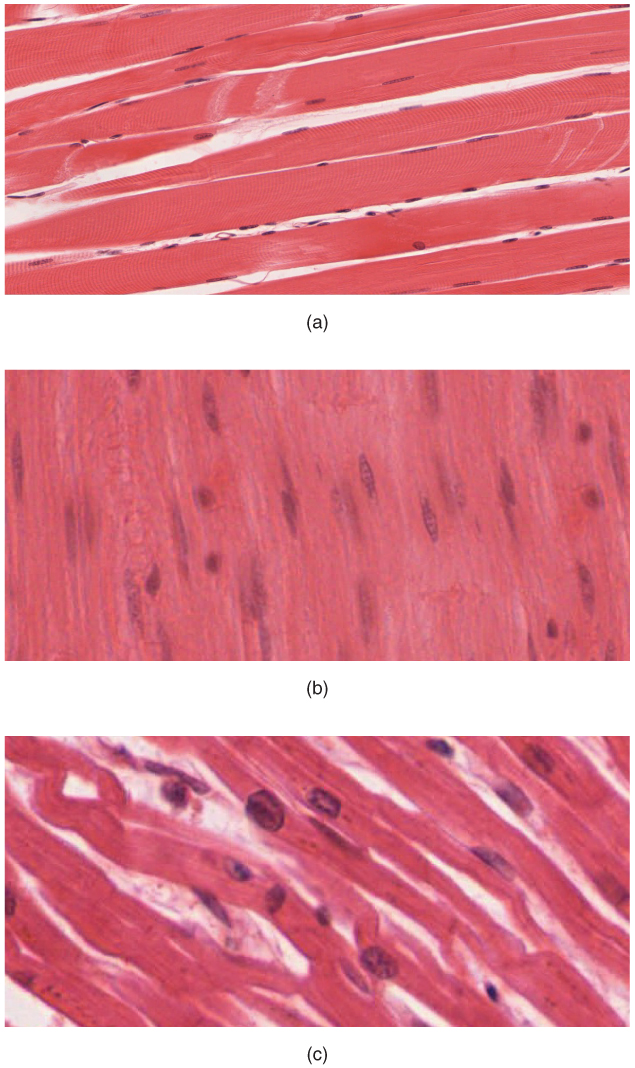
Panels (a), (b) and (c) show skeletal, smooth and cardiac muscle respectively. Compare the tissue photographs with the simplified Explore drawings. Skeletal and cardiac muscle show striations; smooth muscle does not. Use both cell shape and the arrangement of nuclei when comparing them.
Image source and licence
OpenStax College · Source image · CC BY 4.0. Original image, reproduced without alteration.
Organs, systems and the organism
An organ is a structure made of two or more tissue types that performs a specific set of functions. Your stomach, heart, liver and kidney are organs. An organ system is a group of organs that cooperate to carry out a major function for the body; the digestive system includes the mouth, oesophagus, stomach, intestines, liver, gallbladder and pancreas. Medical teaching usually divides the body into about eleven systems, such as the cardiovascular, respiratory, nervous and urinary systems. At the top of the sequence is the organism, the single living being formed by all the systems working together. This highest level is not a sum of independent parts: a change in one system usually alters others, which is why a nurse assesses the patient as a whole rather than one organ at a time.
For example: Breathing supplies oxygen, the blood carries it, and muscle cells use it to release energy. One function already crosses three systems.
 Enlarge illustration ↗
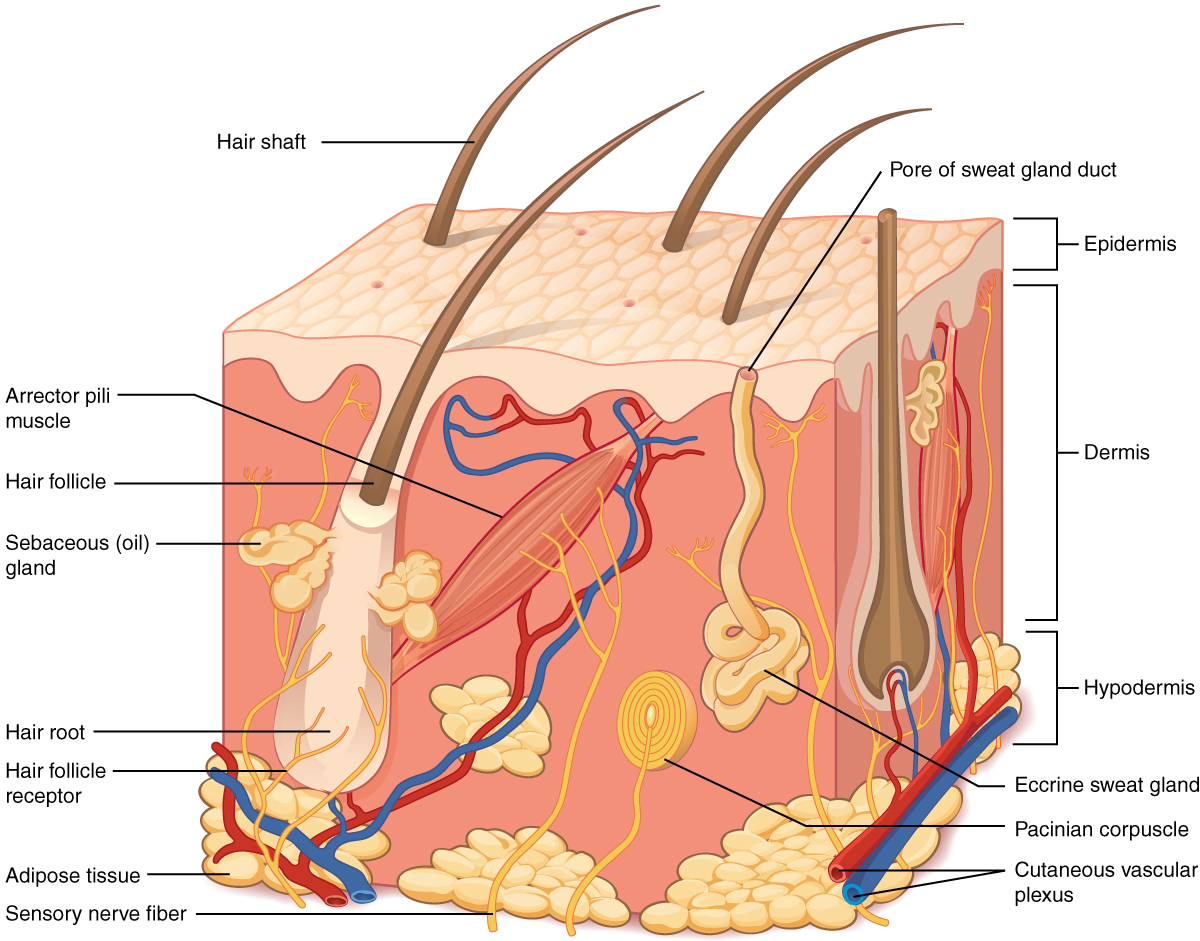
Find the thin surface epithelium above the deeper supporting tissue. Hair follicles and glands extend below the surface. This makes the difference between a surface lining and an entire organ easier to see.
Image source and licence
OpenStax College : J. Gordon Betts, Peter Desaix, Eddie Johnson. · Source image · CC BY 3.0. Original image, reproduced without alteration.
New properties appear at each level
The most important idea in this section is that each level has properties its parts do not have alone. A single protein molecule cannot digest a meal; a stomach can. A single neuron cannot produce thought; a brain network can. These new abilities are sometimes called emergent properties, because they emerge from the arrangement and interaction of the parts rather than from any one part. Emergent properties are the reason a drug, a disease or an injury can affect a whole function even when its first target is one molecule or one cell. They are also why you cannot fully understand health by studying only the smallest components: you must keep moving up and down the levels, connecting a molecule to its cell, its tissue, its organ, its system and the person in front of you.
For example: Pain is an emergent experience: receptors, nerve pathways and the brain each provide a part, but none alone produces the feeling the patient reports.
Common misconception: Learning a lower level does not replace learning a higher one. Knowing the molecules of muscle does not by itself explain how a hand grips an object.
Key facts to remember
- The sequence is: atom → molecule → cell → tissue → organ → organ system → organism.
- A cell is the smallest unit that can carry out all the basic activities of life.
- The four tissue families are epithelial, connective, muscle and nervous tissue.
- An organ contains two or more tissue types; an organ system is a group of organs cooperating on a major function.
- Emergent properties arise from the arrangement and interaction of parts, so the whole can do more than its separate parts.
Example · Trace one muscle contraction down the levels. Atoms form the protein molecules actin and myosin. In a muscle cell these proteins are arranged so the cell can shorten. That cell belongs to muscle tissue. The tissue forms the muscle organ, which attaches to bone. The muscle works with bones and nerves as part of the muscular system, and the movement serves the whole organism when you lift a cup.
Read full notes
Read one topic at a time. These notes explain the mechanisms and relationships behind the key facts.
Why the body is described in levels
No single description captures a living body. Chemistry describes the materials, cells describe the smallest living units, and organ systems describe functions such as breathing or moving. Breaking the body into levels is a practical decision: it lets a problem be studied at the scale where it makes sense. A potassium imbalance is a chemical problem; a weak heart muscle is a cellular and tissue problem; breathlessness is a system-level observation. Clinicians move between levels constantly, because the cause of a problem and its visible effect are often at different scales. The levels are therefore a tool for reasoning, not a ladder that one must always climb from the bottom.
The four tissue families and what they contribute
Epithelial tissue covers and lines surfaces and forms glands. It protects underlying tissue, absorbs substances, and secretes products such as sweat or enzymes. Connective tissue is the most varied family: it includes loose and dense connective tissue, fat, cartilage, bone, blood and lymph. Its tasks include support, binding, protection, insulation, transport and storage. Muscle tissue is specialised to shorten, producing movement of body parts, moving substances through hollow organs, and generating heat. Nervous tissue conducts electrical impulses, allowing rapid communication, sensation and control. Because an organ needs several functions at once, most organs contain several tissue families; learning to recognise them is the fastest route to predicting an organ’s behaviour.
Differentiation: how one cell type becomes many
Almost every cell in your body began from the same fertilised egg and contains the same genetic instructions. Differentiation is the process that turns this shared starting point into the hundreds of specialised cell types that build the body. A cell differentiates by switching particular genes on or off, so it builds the proteins its job requires. This is why a nerve cell is rich in structures for conducting signals while a red blood cell is packed with haemoglobin. Differentiation is mostly stable: a mature nerve cell does not normally turn into a muscle cell. Understanding differentiation helps explain both normal development and disease, because a cell that loses control of which genes are active can behave abnormally.
Organs and systems work in combination
Organs rarely work alone. The heart needs lungs to oxygenate blood, kidneys to control its volume and composition, and nerves to set its rate. The stomach needs the liver and pancreas to supply digestive secretions and the small intestine to absorb the products. This interdependence means that a problem in one system usually produces effects in others, and that an observation may have its cause far from where it is seen. Swelling in the ankles, for example, can arise from the heart, the kidneys, the liver or the vessels themselves. Interdependence is also the reason medical teaching groups organs into systems: the grouping is a study aid, not a claim that the systems are independent.
Emergent properties in nursing reasoning
Emergent properties are the practical reason this course keeps returning to higher levels. Blood pressure is not stored in any single molecule; it emerges from the heart’s output, the resistance of the vessels and the volume of blood. Pain is not stored in one receptor; it emerges from receptors, pathways and the brain. When you assess a patient, you are usually observing an emergent property and then reasoning downward to the levels that produced it. When you intervene, you often act at one level while checking the effect at another: giving a drug that acts on a molecule, then measuring a change in blood pressure or in how the patient feels. Holding several levels in mind at once is a core professional skill.
Explore the diagram
Start with the whole view, then select a numbered structure. Compare the additional illustrations to connect what a structure looks like with what it does.
From molecules to a person
Follow the arrows through six levels. Each larger level contains and organises the smaller ones.
More controls
01 / 6 Chemical level
Atoms bond into molecules. Water is one example.
Chemical level
Atoms join into molecules. Proteins, water and DNA are examples of molecules found in cells.
Illustration credits
- Goran tek-en · Male front 3d-shaded human illustration.svg · CC BY-SA 4.0.
- Mariana Ruiz Villarreal (LadyofHats), Jmarchn · Digestive system without labels.svg · Public domain.


Adapted for this lesson: labels removed, artwork cropped or recoloured, and interactive teaching overlays added. Adapted artwork retains its source licence.
Connect the illustrations to the key ideas
CHEMICAL & CELLULAR · atoms → molecules → cells
Atoms bond into molecules; molecules and organelles build the cell, the smallest living unit.
TISSUE & ORGAN · similar cells → tissue → organ
Similar cells cooperate as tissue; several tissues build an organ such as the stomach.
SYSTEM & ORGANISM · organs → system → whole person
Organs cooperate in systems, and all systems together form the living organism.
Core Concepts Defined
- Atom
- The smallest unit of an element, made of a nucleus and electrons.
- Molecule
- Two or more atoms joined by chemical bonds.
- Macromolecule
- A very large molecule such as a protein, carbohydrate, lipid or nucleic acid.
- Cell
- The smallest unit that can carry out all the basic activities of life.
- Organelle
- A small structure inside a cell that performs a specific job.
- Differentiation
- The process by which a cell becomes specialised for a particular function.
- Tissue
- A group of similar cells and surrounding material working together.
- Organ
- A structure of two or more tissue types performing a specific set of functions.
- Organ system
- A group of organs that cooperate to carry out a major body function.
- Organism
- A single living being formed by all its organ systems working together.
- Emergent property
- An ability that arises from how parts are arranged and interact, not from any part alone.
Go deeper · worked example
From a protein molecule to a working stomach
- Start at the chemical level. Amino acids are small molecules built from atoms; many amino acids joined in a chain form a protein. Digestive enzymes such as pepsin are proteins, and their shape lets them cut other proteins.
- Move to the cellular level. A cell in the stomach lining makes pepsin and releases it. The cell’s organelles build the protein and package it for release; the enzyme is inactive until the cell also releases acid.
- Move to the tissue level. These secretory cells form an epithelium. Muscle tissue in the wall contracts to mix food, and connective tissue holds the layers together.
- Move to the organ level. Together the epithelium, muscle, connective tissue and nerve supply form the stomach, an organ that stores and begins to break down a meal.
- Finish at the system and organism levels. The stomach works with the mouth, intestines, liver, gallbladder and pancreas in the digestive system, and that system serves the whole person.
Explain it yourself · Explain why no single level is enough to describe digesting a meal.
Reveal a model explanation
Each level answers a different question. Molecules explain what enzyme can cut what. The cell explains how the enzyme is made and released. Tissues explain how secretion and mixing are organised. The organ explains storage and controlled release. The system and organism explain how the meal is delivered, absorbed and used and how the person feels. Emergent properties such as efficient digestion exist only when the levels work together.
Check
Answer three questions from this section — one easy, one medium and one hard. If you miss one, you get a fresh set with explanations for the last attempt.
Practise this sectionOpen all questions and filter by difficulty or Bloom levelReferences and review status
OpenStax, Anatomy and Physiology 2e, 1.2 Structural Organization of the Human Body; Tortora & Derrickson, Principles of Anatomy and Physiology, 12e, ch. 1. Author review only; medical and French-language expert review pending.
Optional further reading · English · internet required:
- Anatomy and physiology: an overview
- Structural organisation of the body
- Homeostasis and feedback
- Anatomical terminology
Original teaching schematics. English and French wording is author-reviewed for study; anatomy and French-language expert review is pending. Checks are practice only, not a graded examination.
Practice progress is saved on this device for the current learner.