SECTION 9.5
Hypothalamus–pituitary feedback
Explain how the hypothalamus and pituitary use feedback to control other endocrine glands.
Learn
Many hormones are controlled not by a single gland but by a hierarchy of three levels. The hypothalamus releases a releasing hormone; the anterior pituitary responds by releasing a tropic hormone; and the target gland responds by releasing its own hormone, which acts on the body. Each step amplifies the signal, so a small amount of hypothalamic hormone can produce a large change in the final hormone. The key to stability is feedback: the final hormone travels back in the blood and suppresses the hypothalamus and the pituitary, so secretion falls when the level is high enough. This arrangement keeps hormone levels within narrow ranges and lets the body respond to changing needs. This section explains the hierarchy, the feedback loops and what happens when one level fails.
Key Concepts & Topics
The three-tier hierarchy
The endocrine axes share a common design. At the top, the hypothalamus releases a releasing hormone into a small portal blood system that carries it directly to the anterior pituitary. The anterior pituitary then releases a tropic hormone, so called because it stimulates and maintains another gland. The target gland, such as the thyroid, the adrenal cortex or a gonad, responds by producing its own hormone, which is the one that acts on the body. Because each step involves amplification, the system can make large changes in the final hormone from small changes at the top. It also creates several points at which the response can be adjusted, and several points at which disease can interfere. Growth hormone is a partial exception: it comes from the anterior pituitary but acts largely through a factor produced in the liver, without a separate target gland.
For example: A tiny rise in thyrotropin-releasing hormone from the hypothalamus can produce a much larger rise in thyroid hormone, because each step of the cascade amplifies the signal.
Negative feedback keeps levels stable
Negative feedback is the rule in endocrine control. The final hormone of an axis travels in the blood back to the hypothalamus and anterior pituitary and suppresses their secretion. If thyroid hormone rises, it reduces the release of thyrotropin-releasing hormone and thyroid-stimulating hormone; if it falls, the suppression lifts and the pituitary increases thyroid stimulation. The result is a stable level rather than an on-off system, and it explains why measuring more than one hormone in an axis is informative: the level of the tropic hormone shows how hard the pituitary is pushing. The same logic applies to cortisol, which suppresses adrenocorticotropic hormone, and to the sex steroids, which suppress the gonadotropins. Because feedback is negative, the system tends to return to its set point after disturbance.
For example: In primary hypothyroidism the thyroid fails, so thyroid hormone falls and TSH rises as the pituitary tries to compensate.
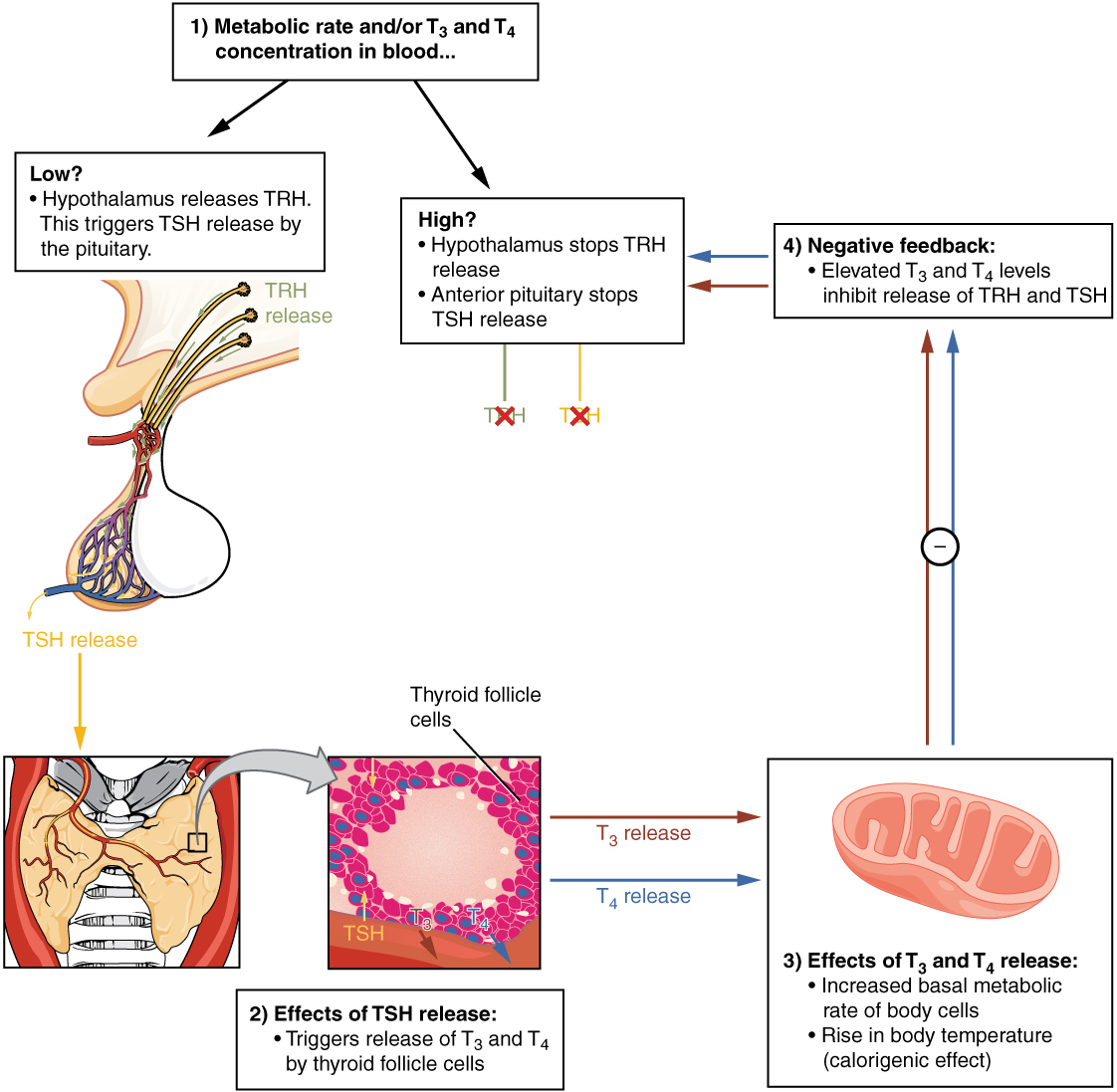 Enlarge illustration ↗
Follow the forward pathway: TRH stimulates TSH release, and TSH stimulates the thyroid. Then follow the feedback lines back: rising thyroid hormone reduces upstream stimulation. Negative feedback describes the direction of control, not a harmful effect.
Image source and licence
OpenStax College · Source image · CC BY 3.0. Original image, reproduced without alteration.
The named axes
Three axes are named and used constantly in clinical reasoning. The hypothalamic–pituitary–thyroid axis runs from thyrotropin-releasing hormone to thyroid-stimulating hormone to T3 and T4. The hypothalamic–pituitary–adrenal axis runs from corticotropin-releasing hormone to adrenocorticotropic hormone to cortisol, and it is central to the stress response. The hypothalamic–pituitary–gonadal axis runs from gonadotropin-releasing hormone to follicle-stimulating hormone and luteinising hormone to the sex steroids and gametes, and it controls reproduction. A fourth, the growth hormone axis, runs from growth hormone-releasing hormone to growth hormone to insulin-like growth factor 1, produced mainly in the liver, which mediates most of growth hormone's effects on growth. Each axis can be tested by measuring its hormones together, because the pattern reveals which level is failing.
For example: A patient with suspected adrenal insufficiency may have cortisol and ACTH measured together, because the combination distinguishes a failing adrenal gland from a failing pituitary.
Positive feedback and biological rhythms
Not all endocrine feedback is negative. Two important examples are positive. During labour, oxytocin causes uterine contraction, and the contraction stimulates more oxytocin release, so the signal intensifies until birth occurs. In the menstrual cycle, rising oestrogen normally suppresses gonadotropins, but at mid-cycle it briefly stimulates a large surge of luteinising hormone, which triggers ovulation. Positive feedback is used when a process must be completed quickly and decisively rather than held steady. Many hormones also follow rhythms. Cortisol rises in the early morning and falls at night, growth hormone is released mainly during deep sleep, and the reproductive hormones cycle monthly. Measuring a hormone without considering its rhythm can therefore be misleading, which is why samples are often taken at a defined time of day.
For example: Cortisol is usually measured in the early morning, when its level is highest, because the result is interpreted against that rhythm.
Primary and secondary disorders
The hierarchy gives clinicians a simple way to classify endocrine disease. If the target gland itself fails, the disorder is primary: the gland's hormone is low and the tropic hormone is high, because feedback has lifted and the pituitary is pushing harder. If the pituitary or hypothalamus fails, the disorder is secondary: the gland's hormone is low and the tropic hormone is low or inappropriately normal, because the drive from above is missing. The same logic applies to excess: a primary excess comes from the gland and suppresses the tropic hormone, while a secondary excess comes from too much tropic hormone and drives the gland. Feedback also explains a common clinical problem: taking steroid medication for a long time suppresses ACTH, so the adrenal cortex shrinks and cannot respond quickly when the drug is stopped abruptly. Treatment therefore often requires gradual withdrawal.
For example: A patient who stops long-term steroid treatment abruptly may develop adrenal crisis, because the suppressed adrenal cortex cannot produce enough cortisol.
Key facts to remember
- Many endocrine axes have three tiers: hypothalamic releasing hormone → anterior pituitary tropic hormone → target-gland hormone.
- Negative feedback means the final hormone suppresses the hypothalamus and pituitary, keeping its own level stable.
- Named axes are the thyroid (TRH–TSH–T3/T4), adrenal (CRH–ACTH–cortisol) and gonadal (GnRH–FSH/LH–sex steroids) axes; growth hormone acts largely through IGF-1 from the liver.
- Positive feedback intensifies a process, as with oxytocin in labour and the mid-cycle LH surge; hormone rhythms such as the cortisol morning peak affect interpretation.
- Primary disorders arise in the target gland and raise the tropic hormone; secondary disorders arise in the pituitary or hypothalamus and lower it.
Example · Follow the thyroid axis. The hypothalamus releases thyrotropin-releasing hormone, which reaches the anterior pituitary and stimulates thyroid-stimulating hormone. TSH travels to the thyroid, which produces T3 and T4. These hormones raise metabolic rate in tissues and also travel back to the hypothalamus and pituitary, where they suppress further releasing hormone and TSH. If the thyroid fails, T3 and T4 fall, the suppression lifts and TSH rises, which is a primary disorder. If the pituitary fails, TSH is low and the thyroid is understimulated, which is secondary. Same axis, two patterns, one feedback rule.
Read full notes
Read one topic at a time. These notes explain the mechanisms and relationships behind the key facts.
The hierarchy and its purpose
The three-tier design gives the endocrine system two advantages. First, amplification: a small signal from the brain produces a large response from a gland, so the system can respond to subtle information without needing large amounts of hypothalamic hormone. Second, multiple points of regulation: the same final hormone level can be achieved by changes at the hypothalamus, the pituitary or the gland, which gives the body flexibility. The hierarchy also allows the nervous system to influence hormone secretion, because the hypothalamus receives neural input about light, stress, temperature and blood composition. This is why psychological stress can change cortisol, why sleep affects growth hormone, and why day length affects reproduction in many animals.
Negative feedback keeps levels stable
Negative feedback is what turns an amplifying cascade into a stable control system. Without it, any stimulation would run away; with it, the final hormone restrains its own production. The feedback acts at more than one level, suppressing both the hypothalamus and the pituitary, which makes the system more stable than a single control point would be. It also means that the tropic hormone is a kind of error signal: when the final hormone is too low, feedback weakens and the tropic hormone rises; when it is too high, feedback strengthens and the tropic hormone falls. Reading the pair together therefore reveals both the level of the hormone and the direction in which the system is trying to move it, which is more informative than either measurement alone.
The named axes
Each named axis has its own clinical fingerprints. The thyroid axis controls metabolic rate, so its failure changes weight, temperature tolerance, heart rate and mental function. The adrenal axis controls the stress response and glucose availability, so its failure causes fatigue, low blood pressure and poor tolerance of illness. The gonadal axis controls reproduction, so its failure affects fertility, secondary sexual characteristics and bone health. The growth hormone axis controls growth in childhood and body composition and metabolism in adults, acting largely through IGF-1 from the liver. Because these axes share the same architecture, the reasoning used for one transfers directly to the others: identify the final hormone, measure the tropic hormone, and decide whether the problem is in the gland or above it.
Positive feedback and rhythms
Positive feedback is used sparingly because it is inherently unstable, but it is exactly what is needed for processes that must go to completion. Labour is the classic example: each contraction releases more oxytocin, which causes stronger contractions, until the baby is born and the stimulus ends. Ovulation is another: a brief switch from negative to positive feedback produces the LH surge that ruptures the follicle. Rhythms add another layer of control. Cortisol peaks in the early morning to prepare the body for activity, growth hormone is released mainly during deep sleep, and reproductive hormones cycle. For clinical measurement this means that timing matters, and for physiology it means that a single value is only meaningful in the context of the rhythm that produced it.
Primary and secondary disorders
The primary–secondary distinction is the practical payoff of the hierarchy, and it works because the tropic hormone reports the direction of the feedback. A low final hormone with a high tropic hormone means the gland is failing and the pituitary is compensating. A low final hormone with a low or inappropriately normal tropic hormone means the pituitary or hypothalamus is failing. Excess states follow the same logic, but in the opposite direction: a primary excess suppresses the tropic hormone, while a secondary excess raises it. The system also creates a treatment hazard: giving a hormone that normally suppresses the axis, such as a steroid, turns off the drive from above, and the suppressed gland can shrink, so stopping abruptly leaves the body unable to respond. This is why long-term steroid treatment must be tapered slowly rather than stopped.
Explore the diagram
Start with the whole view, then select a numbered structure. Compare the additional illustrations to connect what a structure looks like with what it does.
Hormone signals and feedback travel in opposite directions
Example: the hypothalamus–pituitary–thyroid axis. Solid arrows stimulate; dashed return lines ending in a bar inhibit. Other endocrine axes use different hormones.
Releasing hormones link the brain to the anterior pituitary. In this example, TRH stimulates TSH release.
Connect the illustrations to the key ideas
THREE-TIER HIERARCHY · hypothalamus → anterior pituitary → target gland
Each step amplifies the signal; the target gland's hormone acts on the body.
NEGATIVE FEEDBACK · final hormone suppresses the hypothalamus and pituitary
Feedback makes the amplifying cascade stable and predictable.
PRIMARY VERSUS SECONDARY · gland failure raises tropic hormone; pituitary failure lowers it
The tropic hormone reveals which level is failing.
Core Concepts Defined
- Tropic hormone
- An anterior pituitary hormone that stimulates and maintains another endocrine gland.
- Releasing hormone
- A hypothalamic hormone that stimulates release of an anterior pituitary hormone.
- Inhibiting hormone
- A hypothalamic hormone that suppresses release of an anterior pituitary hormone.
- Negative feedback
- Suppression of an earlier step by the final hormone of an axis, which stabilises its level.
- Positive feedback
- Amplification of a process by its own product, as with oxytocin in labour.
- Thyrotropin-releasing hormone (TRH)
- The hypothalamic hormone that stimulates TSH release.
- Corticotropin-releasing hormone (CRH)
- The hypothalamic hormone that stimulates ACTH release.
- Gonadotropin-releasing hormone (GnRH)
- The hypothalamic hormone that stimulates FSH and LH release.
- Hypothalamic–pituitary–thyroid axis
- The TRH–TSH–T3/T4 hierarchy that controls metabolic rate.
- Hypothalamic–pituitary–adrenal axis
- The CRH–ACTH–cortisol hierarchy that controls the stress response.
- Hypothalamic–pituitary–gonadal axis
- The GnRH–FSH/LH–sex steroid hierarchy that controls reproduction.
- Insulin-like growth factor 1 (IGF-1)
- A liver-produced factor that mediates most growth hormone effects.
- Circadian rhythm
- A daily cycle of hormone release, such as the early-morning cortisol peak.
- Primary disorder
- Endocrine disease arising in the target gland itself, with the tropic hormone raised.
- Secondary disorder
- Endocrine disease arising in the pituitary or hypothalamus, with the tropic hormone low or inappropriately normal.
- Adrenal crisis
- A life-threatening state caused by insufficient cortisol, sometimes after abrupt steroid withdrawal.
Go deeper · worked example
Deciding whether a thyroid problem is primary or secondary
- Confirm the hormone level. The patient has symptoms of hypothyroidism, and blood tests show low T3 and T4.
- Measure the tropic hormone. TSH is measured at the same time, because its level shows how hard the pituitary is driving the thyroid.
- Apply the feedback rule. If the thyroid is failing, low T3 and T4 lift the normal suppression, so TSH rises: this is a primary disorder, and the problem lies in the gland.
- Consider the alternative. If TSH is low or inappropriately normal while T3 and T4 are low, the drive from the pituitary is missing, so the disorder is secondary and the problem lies in the pituitary or hypothalamus.
- Translate into treatment. A primary disorder is treated by replacing thyroid hormone; a secondary disorder requires identifying and treating the pituitary or hypothalamic cause, and other pituitary axes are checked because more than one may be affected.
Explain it yourself · Explain why the level of thyroid-stimulating hormone helps identify whether a thyroid problem lies in the thyroid or in the pituitary.
Reveal a model explanation
In the thyroid axis, the hypothalamus releases thyrotropin-releasing hormone, the anterior pituitary releases TSH, and the thyroid releases T3 and T4. T3 and T4 normally suppress both the hypothalamus and the pituitary, so TSH reflects how much drive the thyroid is receiving. If the thyroid itself fails, T3 and T4 fall, the suppression lifts, and TSH rises as the pituitary tries to compensate: this is a primary disorder. If the pituitary or hypothalamus fails, TSH is low or inappropriately normal while T3 and T4 are low, because the drive from above is missing: this is a secondary disorder. Measuring TSH alongside T3 and T4 therefore shows whether the problem is in the gland or in its controller, and the same reasoning applies to cortisol with ACTH and to sex steroids with FSH and LH.
Check
Answer three questions from this section — one easy, one medium and one hard. If you miss one, you get a fresh set with explanations for the last attempt.
Practise this sectionOpen all questions and filter by difficulty or Bloom levelReferences and review status
OpenStax, Anatomy and Physiology 2e, 17.3 The Pituitary Gland and Hypothalamus and 17.4 The Thyroid Gland and 17.5 The Adrenal Glands; Tortora & Derrickson, Principles of Anatomy and Physiology, 12e, ch. 18. Author review only; medical and French-language expert review pending.
Original teaching schematics. English and French wording is author-reviewed for study; anatomy and French-language expert review is pending. Checks are practice only, not a graded examination.
Practice progress is saved on this device for the current learner.