SECTION 1.3
Homeostasis
Explain homeostasis, the role of negative feedback, and what happens when a regulated variable leaves its normal range.
Learn
Homeostasis is the body’s ability to keep its internal conditions steady enough for its cells to work. It does not mean that nothing changes. Body temperature, blood glucose, blood pH, water content and blood pressure all move up and down during the day; homeostasis keeps them inside a range the cells can tolerate. Think of a room thermostat: it does not hold the temperature at exactly one number, it turns heating on and off to stay near a chosen value. The body uses the same kind of control, but with many variables at once and with several systems sharing the work. When a variable leaves its range and the body cannot bring it back, the result is the signs and symptoms you will learn to recognise and explain.
Key Concepts & Topics
A steady internal environment
The fluid around your cells is called the internal environment, or extracellular fluid. Its composition matters because cells are bathed in it: what is dissolved there reaches the cell membrane and influences everything inside. A regulated variable is a measurable quantity the body controls, such as temperature, blood glucose, pH, the concentration of sodium or potassium, water volume or blood pressure. For each variable the body behaves as though there is a set point, a target value, and a normal range, an interval around that value in which the cells work well. Homeostasis is the work of keeping regulated variables inside their ranges. The ranges are not the same for everyone, and they change with age, activity, pregnancy and health, so a value is interpreted with the person and the situation.
For example: Blood pH is normally kept within a very narrow range, tighter than the range for blood glucose. A small pH change is more immediately dangerous than a similar change in glucose.
Why cells need a stable environment
Cells work through molecules, and molecules are sensitive to their surroundings. Enzymes — proteins that speed up reactions — have a shape that fits their target, and that shape depends on temperature and pH; too much heat or too much acid distorts the shape and slows or stops the reaction. Cell membranes depend on the balance of water and dissolved particles to keep the right volume and to move substances in and out. Nerve and muscle cells rely on precise differences in sodium, potassium and calcium across their membranes to produce electrical signals. This is why the body devotes so much effort to regulation: a change that seems small on a monitor can alter how every cell in a tissue behaves.
For example: A high fever makes a patient drowsy and confused because nerve cells depend on stable temperature and ion balance to signal reliably.
Negative feedback: the core control loop
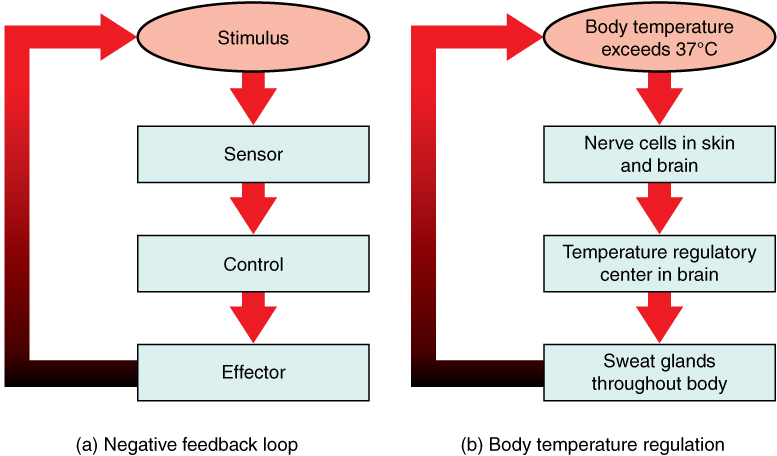
Most regulation uses negative feedback. A change — the stimulus — is detected by a sensor called a receptor. The receptor sends information to a control centre, which compares the value with the set point and decides on a response. The control centre signals an effector, a structure that carries out the response, such as a muscle, a gland or a blood vessel. The response opposes the original change, reducing the deviation, so the variable returns towards its range. Because the response turns the change down, the loop is called negative. Body temperature is a familiar example: when you get too warm, receptors report this to the control centre in the brain, which signals sweat glands to produce sweat and skin blood vessels to widen; heat is lost, and temperature falls.
For example: After a sugary meal, blood glucose rises, the pancreas releases insulin, cells take up glucose, and the level falls back towards its range.
Common misconception: Negative feedback does not mean a harmful or ‘bad’ response. Negative describes the direction: the response reduces the original change.
 Enlarge illustration ↗
Compare the two columns: a sensor detects a change, a control centre processes it, and an effector responds. Evaporation of sweat helps lower temperature, opposing the original rise. The 37°C shown is a teaching reference, not a fixed temperature for everyone.
Image source and licence
OpenStax · Source image · CC BY 4.0. Original image, reproduced without alteration.
Positive feedback: useful amplification
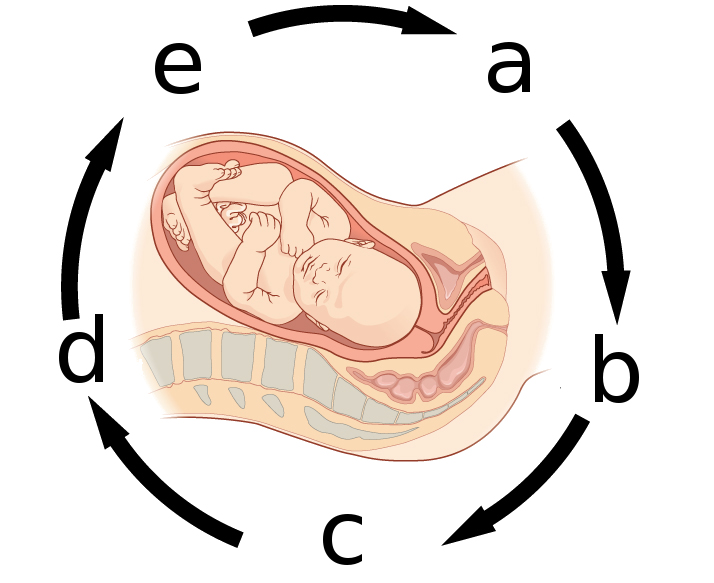
A few processes use positive feedback, in which the response increases the original change instead of reducing it. Because this can run away, positive feedback loops in the body are always self-limiting or end with an external event. During childbirth, contractions push the baby against the cervix; stretch receptors signal the brain to release oxytocin, a hormone that makes contractions stronger still. The loop continues until the baby is delivered, which removes the stimulus. Blood clotting works in the same amplifying way: activated platelets attract more platelets until the vessel is sealed, and the clot itself limits further activation. Positive feedback is therefore not a fault; it is a design used where a process must finish quickly and decisively.
For example: In severe bleeding, platelet activation recruits more platelets at the same spot, building a plug quickly rather than slowly.
 Enlarge illustration ↗
Follow the letters: (a) the brain signals oxytocin release from the posterior pituitary; (b) blood carries oxytocin to the uterus; (c) contractions strengthen; (d) the baby presses on the cervix; (e) nerve signals return to the brain. This amplifies the stimulus until birth removes the cervical stretch.
Image source and licence
OpenStax — CNX Textbook of Anatomy and Physiology · Source image · CC BY 4.0. Original image, reproduced without alteration.
Compensation, decompensation and disease
Homeostasis is not all-or-nothing. When a variable is pushed away from its range, the body first tries to compensate: it works harder to bring the value back. Compensation may hold the measured value near normal for a while, hiding how hard the body is working. If the disturbance continues or the compensating systems tire, compensation fails — decompensation — and the variable moves clearly outside its range, producing signs and symptoms. This sequence explains why a patient can look stable and then deteriorate quickly. Recognising compensation means looking for the effort (a raised heart rate, faster breathing, sweating) as well as the number on the display, and understanding that a ‘normal’ reading may itself be the result of exhausting work.
For example: A patient losing fluid may keep a near-normal blood pressure by narrowing vessels and raising the heart rate; when that effort fails, pressure falls suddenly.
Common misconception: A normal measurement does not prove the body is at ease. It may reflect successful, strenuous compensation that is close to failing.
Key facts to remember
- Homeostasis keeps regulated variables inside a tolerable range; it is a steady state, not a fixed value.
- A negative-feedback loop has a receptor (sensor), a control centre, an effector and a response that reduces the original change.
- Positive feedback amplifies a change and is always self-limiting or ended by an external event, as in childbirth and clotting.
- Enzymes, membranes and excitable cells depend on stable temperature, pH and ion balance.
- Compensation can hold a value near normal while the body works hard; decompensation means that effort has failed.
Example · On a hot day, temperature rises above the set point. Receptors in the skin and body core detect the change. The control centre in the brain compares it with the set point and signals effectors: sweat glands increase sweating, and skin blood vessels widen. Evaporation and increased skin blood flow lose heat, so the temperature falls back towards range. If the person cannot drink and the heat continues, compensation may fail and heat exhaustion follows.
Read full notes
Read one topic at a time. These notes explain the mechanisms and relationships behind the key facts.
A steady state, not a fixed state
It is tempting to imagine homeostasis as a machine holding one exact number. Real regulation is more like steering: the value drifts, the system corrects, and the correction overshoots slightly before settling. Blood glucose rises after a meal and falls between meals; body temperature is lower in the early morning and higher in the late afternoon. These movements are normal. What matters is that the variable stays inside a range that keeps cells working. This is why clinicians compare a measurement with the person’s own usual values and with the situation, rather than with a single number. A steady state allows controlled variation around a set point; a fixed state would not survive the demands of eating, moving, sleeping and fighting infection.
The control loop, part by part
Every negative-feedback loop can be described with the same four parts, and learning to name them turns a confusing process into a checklist. The receptor detects the value; the control centre compares it with the set point and decides; the effector carries out the response; and the response reduces the original deviation, closing the loop. Different variables use different parts. For blood glucose, the receptors are in the pancreas, the control centre is also pancreatic, and the effectors are cells that store or release glucose, plus the liver. For blood pressure, stretch receptors in large arteries detect the value, the brainstem is the control centre, and the effectors are the heart and blood vessels. Naming the parts lets you predict what happens when one of them fails.
Negative and positive feedback compared
The two kinds of feedback differ in direction and in purpose. Negative feedback opposes change and is used wherever stability is the goal; it is by far the more common pattern. Positive feedback amplifies change and is used only where a process must reach a definite end quickly, such as delivering a baby or sealing a damaged vessel. The risk of positive feedback is obvious: an amplifying loop with no stopping condition would be dangerous, so each one has a built-in ending. In clotting, the growing clot limits further platelet activation; in labour, delivery removes the stretch that started the loop. Understanding the difference prevents a common error: assuming that every useful control must reduce its stimulus. Direction, not desirability, defines the type.
Compensation and its limits
The body rarely gives up at the first disturbance. It compensates: it changes the activity of organs so that the measured variable stays near its range. Compensation is why a patient can lose a litre of blood and still have a normal blood pressure reading in the first minutes, and why a person with an early lung problem can keep oxygen levels acceptable by breathing faster. Compensation is useful but expensive, and it has limits. It consumes energy, it may require water or nutrients the person does not have, and it can hide a serious problem behind reassuring numbers. Recognition is a clinical skill: look for the effort behind the value, ask how long it can last, and treat the cause rather than the reading alone.
Homeostasis across the lifespan
The ability to regulate is not constant through life. Infants lose heat quickly because they have a large surface area relative to their body mass, and their fluid balance changes fast because a large share of their body is water. Older adults often have a reduced reserve: they may not develop a fever during infection, may feel less thirst, and may regulate blood pressure less tightly on standing. Pregnancy changes set points for several variables, including fluid volume and blood pressure. None of these changes is a disease by itself, but each alters how a measurement should be interpreted and how quickly compensation may fail. Homeostasis is therefore best understood as a capacity that varies with the person and the moment, not a fixed property of all bodies.
Explore the diagram
Start with the whole view, then select a numbered structure. Compare the additional illustrations to connect what a structure looks like with what it does.
A negative feedback loop
Read from change to detection and control, then response. The response reduces the original disturbance.
More controls
01 / 4 A change is detected
A change is detected
Example: body temperature rises. Temperature-sensitive receptors provide information.
Connect the illustrations to the key ideas
DEVIATION DETECTED · receptor senses a change
A receptor detects that a regulated variable has moved away from its set point.
CONTROL AND RESPONSE · control centre signals an effector
The control centre compares the value with the set point and an effector carries out the response.
DEVIATION REDUCED · the variable returns to range
The response opposes the original change, so the variable moves back towards its normal range.
Core Concepts Defined
- Homeostasis
- The maintenance of internal conditions within ranges the body’s cells can tolerate.
- Internal environment (extracellular fluid)
- The fluid surrounding cells, whose composition the body regulates.
- Regulated variable
- A measurable quantity the body controls, such as temperature, pH or blood glucose.
- Set point
- The target value a control system works to keep near.
- Normal range
- The interval around a set point in which cells and organs work well.
- Receptor (sensor)
- A structure that detects a change in a regulated variable.
- Control centre
- The part of the system that compares the detected value with the set point and decides the response.
- Effector
- The structure that carries out the response, such as a muscle, gland or blood vessel.
- Negative feedback
- A control loop in which the response reduces the original change.
- Positive feedback
- A control loop in which the response increases the original change; it is self-limiting or ends with an external event.
- Compensation
- The body’s effort to keep a variable near its range while under stress.
- Decompensation
- Failure of compensation, when a variable moves clearly outside its range.
Go deeper · worked example
Too hot outdoors: reading a feedback loop
- Identify the regulated variable and the direction of change. Body temperature is rising above its set point, so the stimulus is an increase in temperature.
- Name the receptor. Temperature-sensitive receptors in the skin and in the body core detect the change and send signals to the control centre.
- Name the control centre. The control centre in the brain compares the detected temperature with the set point and selects a response.
- Name the effectors and the response. Sweat glands increase sweating, and blood vessels in the skin widen to send more blood near the surface. Both actions lose heat.
- Check the loop and its limit. Temperature falls back towards range, so the loop is negative. If fluid is not replaced, sweating slows and compensation can fail, leading to heat exhaustion.
Explain it yourself · Explain why a person can feel unwell on a hot day even though the measured temperature has returned to normal.
Reveal a model explanation
The measurement can look normal because compensation is maintaining it, not because the body is at ease. Sweating and widened skin vessels cost water and energy; if fluid is not replaced, blood volume falls and the heart works harder. The value on the thermometer reflects the result of continuous effort, and the person may feel weak, thirsty or dizzy before the temperature itself drifts.
Check
Answer three questions from this section — one easy, one medium and one hard. If you miss one, you get a fresh set with explanations for the last attempt.
Practise this sectionOpen all questions and filter by difficulty or Bloom levelReferences and review status
OpenStax, Anatomy and Physiology 2e, 1.5 Homeostasis; Tortora & Derrickson, Principles of Anatomy and Physiology, 12e, ch. 1. Author review only; medical and French-language expert review pending.
Optional further reading · English · internet required:
- Anatomy and physiology: an overview
- Structural organisation of the body
- Homeostasis and feedback
- Anatomical terminology
Original teaching schematics. English and French wording is author-reviewed for study; anatomy and French-language expert review is pending. Checks are practice only, not a graded examination.
Practice progress is saved on this device for the current learner.