SECTION 4.2
Haemopoiesis and blood-cell roles
Explain haemopoiesis and describe the specific roles of red cells, the five white-cell types and platelets.
Learn
Blood cells do not live forever. Red cells last about 120 days, platelets a week or two, and some white cells only hours, so the body must replace them continuously. That replacement is haemopoiesis, the formation of blood cells. It happens mainly in the red bone marrow, the tissue inside certain bones, and it begins with a single kind of cell: a pluripotent stem cell that can divide and become any of the blood cell types. Because the demand changes constantly, production is controlled by feedback: low oxygen stimulates more red cell production, infection stimulates more white cell production, and platelet loss stimulates more platelet production. This section explains where blood cells come from and what each mature cell does, connecting production to the roles you met in section 4.1.
Key Concepts & Topics
Haemopoiesis: making blood cells
Haemopoiesis is the production of the formed elements of blood. Before birth it occurs in the liver, spleen and other sites; after birth it takes place mainly in red bone marrow, found in the sternum, ribs, vertebrae, pelvis and the ends of long bones. Red marrow contains stem cells together with the supporting cells and vessels needed to feed them, and it can switch production from one cell type to another as needs change. The scale is remarkable: the body replaces hundreds of billions of blood cells every day, which means the marrow is one of the most active tissues in the body. Because production requires continuous cell division and protein synthesis, it is sensitive to nutrition, especially iron, vitamin B12 and folate, and to any condition that damages the marrow or suppresses division.
For example: A patient receiving chemotherapy may develop low blood counts because the drug suppresses cell division, and marrow cells divide more than almost any others.
The stem cell and its two lineages
All blood cells descend from a pluripotent stem cell, also called a haemocytoblast. This single cell type can divide to produce more stem cells and also to produce two broad lines of descendants. The myeloid lineage gives rise to red blood cells, platelets, and the granulocytes and monocytes — that is, neutrophils, eosinophils, basophils and macrophages. The lymphoid lineage gives rise to lymphocytes, the T cells, B cells and natural killer cells of immunity. As each descendant matures, it follows a sequence of recognisable stages and finally enters the blood with a specific job. The stem cell itself is rare, and its descendants divide many times before maturing, which amplifies production enormously. This hierarchy also explains why a single marrow disorder can affect several blood cell types at once.
For example: The myeloid and lymphoid branches explain why leukaemia can arise from either line, producing very different patterns of disease.
Erythropoiesis and the roles of red cells
Erythropoiesis is the production of red blood cells. It is stimulated by erythropoietin, a hormone released mainly by the kidneys when they detect reduced oxygen delivery. The marrow responds by increasing red cell production, and the new cells enter the blood after losing their nucleus; a young red cell still containing traces of organelles is called a reticulocyte. Producing red cells requires iron for haemoglobin, vitamin B12 and folate for DNA synthesis, and adequate protein. Mature red cells have three main roles: they transport oxygen bound to haemoglobin, they carry a share of carbon dioxide back to the lungs, and they help buffer blood pH through haemoglobin. Because red cells have no nucleus, they cannot divide or repair themselves fully, which is why their lifespan is finite and why continuous production is essential.
For example: When the kidneys detect low oxygen, they release erythropoietin; the marrow then speeds up red cell production, which is why people adapt to high altitude over weeks.
White cell roles and the differential count
White cells are produced in the marrow from the same stem cell and then mature into specialised defenders. Neutrophils are fast phagocytes that arrive first at bacterial infection. Eosinophils act against parasites and contribute to allergic responses. Basophils release histamine and heparin, promoting inflammation and limiting clotting. Lymphocytes provide specific immunity: B cells produce antibodies that bind particular antigens, while T cells destroy infected cells and regulate the immune response. Monocytes circulate and then become macrophages, which engulf debris and microbes and present antigens to lymphocytes. A differential count reports the percentage of each type, and the pattern is informative: a neutrophil rise suggests bacterial infection, an eosinophil rise suggests allergy or parasites, and a lymphocyte rise often suggests a viral infection.
For example: A differential count showing 85% neutrophils points strongly towards a bacterial cause, whereas 70% lymphocytes points more towards a viral one.
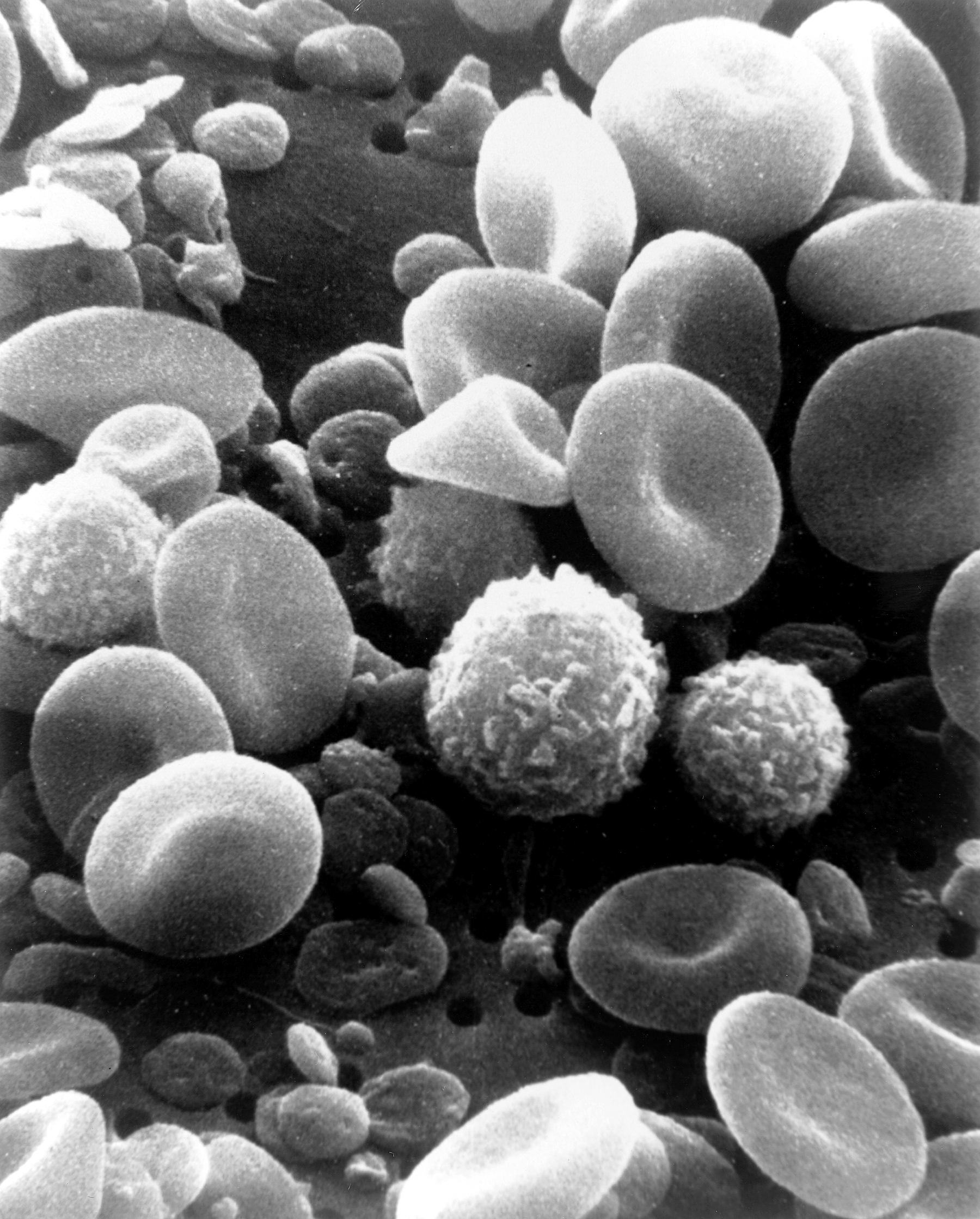 Enlarge illustration ↗
Look for the many disc-shaped red cells and the larger cells with uneven surfaces. This electron-microscope view reveals surface texture; it looks different from a stained blood film viewed with a light microscope.
Image source and licence
Bruce Wetzel (photographer). Harry Schaefer (photographer) · Source image · Public domain. Original image, reproduced without alteration.
Platelet production and how the body adjusts
Platelets are produced in the marrow from megakaryocytes, huge cells that break off fragments under the control of the hormone thrombopoietin. Production is balanced with removal, mainly by the spleen, so the count stays stable. The body adjusts all three lines by feedback. A fall in oxygen delivery raises erythropoietin and red cell production. An infection raises chemical signals that increase white cell production and release cells from marrow stores. A fall in platelet number raises thrombopoietin and platelet production. Each loop has the same logic as the homeostatic control described in section 1.3: a sensor detects a change, a control centre releases a signal, and the marrow, acting as the effector, adjusts production. When the loop fails, the result is a low or high cell count with matching consequences.
For example: After major bleeding, the marrow increases production of red cells and platelets together, and the reticulocyte count rises within days as new red cells are released.
Key facts to remember
- Haemopoiesis occurs mainly in red bone marrow and replaces hundreds of billions of blood cells daily.
- All blood cells arise from a pluripotent stem cell that produces a myeloid and a lymphoid lineage.
- Erythropoiesis is stimulated by erythropoietin from the kidneys and requires iron, vitamin B12, folate and protein.
- White cells mature into five types, and the differential count pattern helps suggest bacterial, allergic, parasitic or viral causes.
- Platelets are produced from megakaryocytes under thrombopoietin control, and production is balanced with splenic removal.
Example · A climber moves to high altitude, where the air contains less oxygen. The kidneys detect reduced oxygen delivery and release erythropoietin. The red marrow responds by producing more red blood cells, and over weeks the haematocrit rises, increasing the blood’s oxygen-carrying capacity. If the climber also develops an infection, the marrow shifts part of its output towards white cells, and the differential count shows a neutrophil rise. The same marrow, directed by different signals, adjusts production to match two different needs.
Read full notes
Read one topic at a time. These notes explain the mechanisms and relationships behind the key facts.
Where blood cells are made
In an adult, blood cell production is concentrated in red bone marrow, but this is the end of a longer story. In the developing embryo, blood cells are made in the yolk sac, then in the liver and spleen, and only later does the marrow take over. At birth almost all marrow is red and active; with age much of it in the long bones is replaced by fat and becomes yellow marrow, which stores energy rather than making cells. Red marrow persists in the sternum, ribs, vertebrae, pelvis and the proximal ends of the femur and humerus. This distribution matters in practice: a marrow sample is often taken from the sternum or the back of the pelvis because those sites remain active, and it explains why disorders that replace marrow, such as some cancers, cause a fall in several blood cell types at once.
The stem cell and its lineages
The pluripotent stem cell is rare but immensely productive because each division produces cells that divide again, amplifying the output at every step. Two main branches emerge. The myeloid branch supplies the cells of immediate defence and oxygen transport: red cells, platelets, neutrophils, eosinophils, basophils and monocytes. The lymphoid branch supplies the cells of specific immunity: lymphocytes, including T cells, B cells and natural killer cells. As each cell matures it becomes more specialised and less able to divide, until the mature cell enters the blood. A mature red cell has given up its nucleus altogether, while a lymphocyte retains the ability to divide when activated. The hierarchy explains both the enormous daily output and why a single stem cell fault can produce a disease affecting several cell lines.
Erythropoiesis and what red cells need
Making a red cell is a substantial manufacturing task. The marrow must build haemoglobin, which requires iron, and must copy DNA, which requires vitamin B12 and folate. A shortage of any one of these slows production and produces anaemia with characteristic features: iron deficiency gives small, pale red cells, while vitamin B12 or folate deficiency gives large, immature ones. Erythropoietin sets the rate. When oxygen delivery falls, the kidneys release more, and the marrow responds. When oxygen delivery is adequate, the signal falls and production slows. This is classic negative feedback, and it explains why chronic lung disease or heart failure, which reduce oxygen delivery, can raise red cell production, and why living at altitude does the same.
White cell production and the differential count
White cell production is more variable than red cell production because it responds to infection and inflammation rather than to a steady need. Some white cells are stored in the marrow as a reserve and can be released quickly; others, such as neutrophils, move to the site of infection within minutes. The differential count turns this activity into information. A high neutrophil proportion suggests a bacterial cause; a high eosinophil proportion suggests allergy or parasites; a high lymphocyte proportion suggests a viral cause or a chronic immune process. Because the total white cell count can rise, fall or stay normal, the proportion is often more informative than the total. Reading a differential count with the clinical picture is an example of using a laboratory value to confirm a physiological prediction rather than in isolation.
How the body adjusts production
The three blood cell lines are controlled by feedback loops that share a common structure. A sensor detects a change: low oxygen, infection, or a fall in platelet number. A control centre releases a signal: erythropoietin, immune signalling molecules or thrombopoietin. The red marrow acts as the effector, adjusting production of the appropriate line. Each loop also has a closing step: when the problem is corrected, the signal falls and production returns towards balance. This design explains both the body’s flexibility and its failure modes. If the sensor fails, as in kidney disease, production is misdirected. If the effector fails, as in marrow disease, no amount of signal helps. Understanding the loop tells you where to look when a blood count is abnormal.
Explore the diagram
Start with the whole view, then select a numbered structure. Compare the additional illustrations to connect what a structure looks like with what it does.
The components of blood
A magnified teaching view. Cells and fragments are suspended in plasma; colours are illustrative.
More controls
01 / 4 Red blood cell
Red blood cell
The flattened disc has a thinner centre. Haemoglobin inside carries most blood oxygen.
Blood cells share a marrow origin
Simplified lineage map. Several intermediate precursors are omitted. Platelets are cell fragments, not small complete cells.
A self-renewing cell in red bone marrow gives rise to the blood-cell lineages. Hormonal and local signals regulate production.
Connect the illustrations to the key ideas
STEM CELL · pluripotent cell in red marrow
It divides repeatedly, amplifying production before descendants mature.
TWO LINEAGES · myeloid and lymphoid branches
Myeloid gives red cells, platelets, granulocytes and monocytes; lymphoid gives lymphocytes.
MATURE CELLS IN BLOOD · controlled by EPO, immune signals, thrombopoietin
Feedback adjusts each line to the body’s current need.
Core Concepts Defined
- Haemopoiesis
- The formation of blood cells, mainly in red bone marrow.
- Red bone marrow
- The blood-forming tissue inside the sternum, ribs, vertebrae, pelvis and ends of long bones.
- Pluripotent stem cell (haemocytoblast)
- The marrow cell from which all blood cells descend.
- Myeloid lineage
- The line of descent giving red cells, platelets, granulocytes and monocytes.
- Lymphoid lineage
- The line of descent giving lymphocytes and related immune cells.
- Erythropoiesis
- The production of red blood cells.
- Erythropoietin (EPO)
- A hormone released mainly by the kidneys that stimulates red cell production.
- Reticulocyte
- A young red blood cell that still contains traces of organelles.
- Thrombopoietin
- A hormone that stimulates platelet production.
- Megakaryocyte
- A large marrow cell that breaks off fragments to form platelets.
- Differential count
- A report of the percentage of each white blood cell type.
- Anaemia
- A condition in which the blood’s oxygen-carrying capacity is reduced, often by too few or abnormal red cells.
Go deeper · worked example
Adapting to high altitude
- Detect the change. At altitude the air contains less oxygen, so oxygen delivery to the tissues, including the kidneys, falls.
- Release the signal. The kidneys sense the reduced oxygen and release erythropoietin into the blood.
- Stimulate the effector. Erythropoietin reaches the red bone marrow and increases the rate of red blood cell production.
- Raise the capacity. Over one to several weeks, more red cells enter the blood and the haematocrit rises, increasing oxygen-carrying capacity.
- Close the loop and note the limits. Better oxygen delivery reduces the erythropoietin signal, so production falls back towards balance; production still needs iron, vitamin B12 and folate.
Explain it yourself · Explain why a person with kidney failure may become anaemic even though the bone marrow is healthy.
Reveal a model explanation
The kidneys detect reduced oxygen and release erythropoietin, the hormone that tells the marrow to make more red cells. If the kidneys are damaged, they release too little erythropoietin, so the marrow receives a weak signal and produces fewer red cells even though it is capable. The result is anaemia driven by a missing hormone rather than by a marrow defect. This is why anaemia is common in kidney disease and why treatment may include replacing the hormone signal.
Check
Answer three questions from this section — one easy, one medium and one hard. If you miss one, you get a fresh set with explanations for the last attempt.
Practise this sectionOpen all questions and filter by difficulty or Bloom levelReferences and review status
OpenStax, Anatomy and Physiology 2e, 18.2 Production of the Formed Elements and 18.4 Leukocytes and Platelets; Tortora & Derrickson, Principles of Anatomy and Physiology, 12e, ch. 19. Author review only; medical and French-language expert review pending.
Original teaching schematics. English and French wording is author-reviewed for study; anatomy and French-language expert review is pending. Checks are practice only, not a graded examination.
Practice progress is saved on this device for the current learner.