SECTION 9.4
Endocrine glands and their hormones
Identify the main endocrine glands, the hormones they release and the general effect of each hormone.
Learn
The endocrine system communicates by chemical messengers. Endocrine glands have no ducts: they release hormones into the blood, and the hormones travel to distant cells that carry matching receptors. Only cells with the right receptor respond, which is why a hormone can circulate everywhere but affect only its target tissues. Hormones fall into three chemical groups, and the group determines how a hormone acts: amine hormones are derived from single amino acids, peptide and protein hormones are chains of amino acids, and steroid hormones are made from cholesterol. Water-soluble hormones act on receptors on the cell surface, while lipid-soluble hormones enter the cell and act on receptors inside it. This section identifies the main endocrine glands and the general effect of the hormones they release.
Key Concepts & Topics
Endocrine glands and hormone types
An endocrine gland secretes hormones into the blood, whereas an exocrine gland secretes through a duct onto a surface or into a cavity. Some organs do both: the pancreas releases digestive enzymes through ducts and insulin and glucagon into the blood. Hormones are grouped by chemistry, and the group predicts behaviour. Amine hormones, such as thyroid hormone and the catecholamines, are built from single amino acids. Peptide and protein hormones, such as insulin, growth hormone and ADH, are chains of amino acids; they are water-soluble and act on receptors on the cell surface, triggering second messengers inside the cell. Steroid hormones, such as cortisol, aldosterone and the sex hormones, are lipid-soluble, so they diffuse through the cell membrane and bind receptors inside the cell, usually changing gene activity. This difference explains why steroid effects often take longer to appear but last longer.
For example: Insulin, a protein hormone, acts within minutes on cell-surface receptors, while cortisol, a steroid, alters gene activity and its full effects develop over hours.
 Enlarge illustration ↗
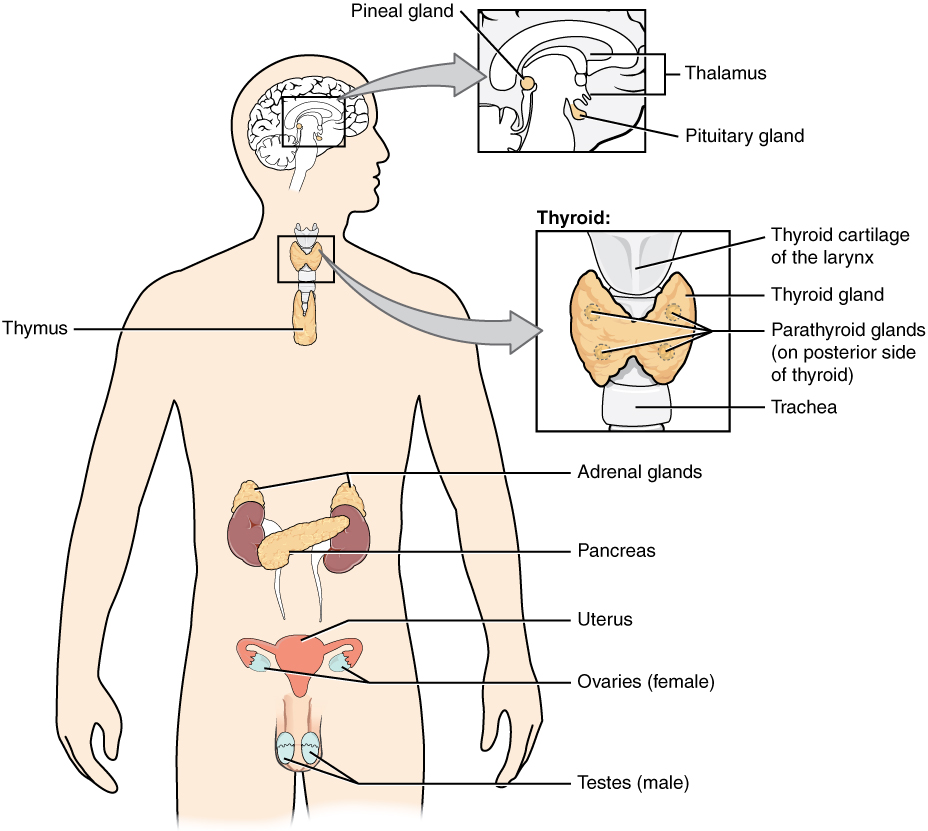
Follow the glands from the brain to the neck and abdomen. The ovarian and testicular examples share this teaching map for comparison. Endocrine organs are distributed throughout the body rather than connected by a common duct. Their hormones travel through blood to responsive target cells.
Image source and licence
OpenStax College · Source image · CC BY 3.0. Original image, reproduced without alteration.
Hypothalamus and pituitary gland
The hypothalamus is the link between the nervous and endocrine systems. It produces releasing and inhibiting hormones that travel a short distance to the anterior pituitary and control its secretion. The pituitary gland has two parts. The posterior pituitary stores and releases two hormones made by the hypothalamus: oxytocin, which stimulates uterine contraction during birth and milk release during breastfeeding, and antidiuretic hormone, which increases water reabsorption by the kidneys. The anterior pituitary produces its own hormones: growth hormone, which promotes growth and affects metabolism; thyroid-stimulating hormone, which controls the thyroid; adrenocorticotropic hormone, which controls the adrenal cortex; follicle-stimulating hormone and luteinising hormone, which control the gonads; and prolactin, which stimulates milk production. Because the anterior pituitary commands other glands, it is often called the master gland, though it is itself controlled by the hypothalamus.
For example: Nursing a baby stimulates oxytocin release, which causes milk ejection; the same hormone also causes the uterine contractions of labour.
Thyroid and parathyroid glands
The thyroid gland lies in the neck in front of the trachea and produces two main hormones. Thyroid hormone, in its two forms T3 and T4, sets the basal metabolic rate: it increases the rate at which cells use oxygen and produce heat, and it is needed for normal growth and brain development. Calcitonin, produced by the thyroid, lowers blood calcium by promoting its deposition in bone. The parathyroid glands are four small glands on the back of the thyroid, and they produce parathyroid hormone, which does the opposite of calcitonin: it raises blood calcium by stimulating bone breakdown, increasing calcium reabsorption by the kidney and activating vitamin D so that more calcium is absorbed from the intestine. Calcium control matters because calcium is needed for nerve and muscle function, including the heart. If the thyroid enlarges, the visible swelling in the neck is called a goitre.
For example: An overactive thyroid raises metabolic rate, causing weight loss, a fast heart rate and heat intolerance; an underactive thyroid does the opposite.
Adrenal glands
Each adrenal gland sits on top of a kidney and has two functionally different parts. The outer adrenal cortex produces steroid hormones. Cortisol, a glucocorticoid, helps the body respond to stress by raising blood glucose and moderating inflammation and immune responses. Aldosterone, a mineralocorticoid, controls sodium reabsorption and potassium secretion in the kidney and therefore blood volume and pressure. The cortex also produces small amounts of androgens that contribute to body-hair growth and sex drive. The inner adrenal medulla produces the catecholamines epinephrine and norepinephrine, which are released rapidly during stress and produce the fight-or-flight response: a faster heart, dilated airways, raised blood glucose and diverted blood flow to muscles. Because the two parts are different in origin and chemistry, they respond to different signals and on different timescales.
For example: A sudden fright triggers adrenal medulla release of epinephrine within seconds, while cortisol rises more slowly and supports a sustained stress response.
Pancreas, pineal gland and other endocrine tissues
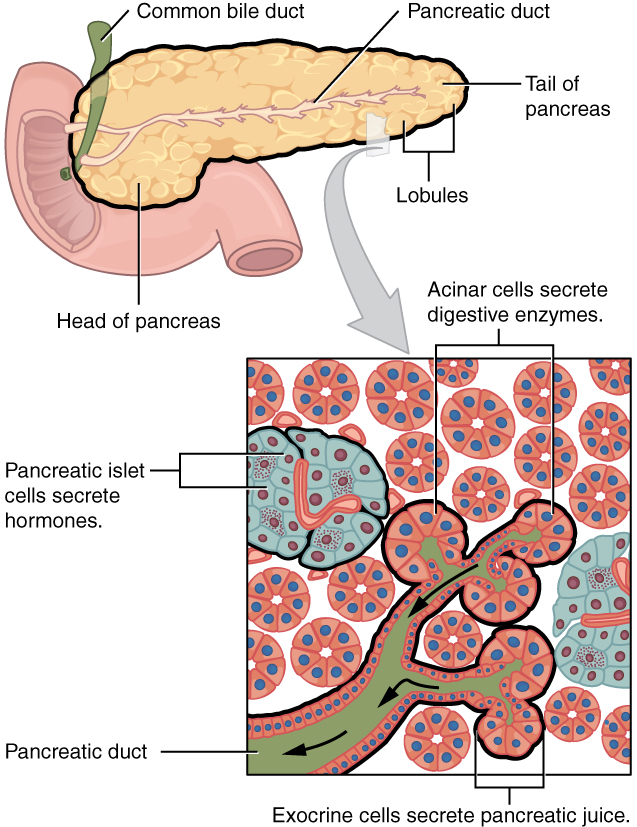
The pancreas is both exocrine and endocrine. Scattered among its digestive tissue are clusters called pancreatic islets, which contain several cell types. Beta cells produce insulin, which lowers blood glucose by promoting glucose uptake into cells and storage as glycogen. Alpha cells produce glucagon, which raises blood glucose by stimulating glycogen breakdown and glucose release from the liver. Delta cells produce somatostatin, which moderates the secretion of the other two. Together these hormones keep blood glucose within a narrow range, and their failure produces diabetes. Other endocrine tissues include the pineal gland, which secretes melatonin and helps regulate sleep–wake rhythms; the thymus, which produces hormones involved in T-cell maturation; the gonads, which produce sex steroids and control reproduction; and the placenta, which acts as a temporary endocrine organ during pregnancy.
For example: In type 1 diabetes, beta cells are destroyed, so insulin is absent and blood glucose rises unless insulin is given.
 Enlarge illustration ↗
Compare the acini connected to ducts with the islets among them. Exocrine secretions travel through ducts to the intestine; endocrine hormones enter the blood. One organ contains two different routes of secretion.
Image source and licence
OpenStax College · Source image · CC BY 3.0. Original image, reproduced without alteration.
Key facts to remember
- Endocrine glands are ductless and release hormones into the blood; only cells with the matching receptor respond.
- Amine and peptide hormones are water-soluble and act on cell-surface receptors; steroid hormones are lipid-soluble and act on receptors inside the cell.
- The posterior pituitary releases oxytocin and ADH made by the hypothalamus; the anterior pituitary releases growth hormone, TSH, ACTH, FSH, LH and prolactin.
- Thyroid hormone sets the metabolic rate and calcitonin lowers blood calcium, while parathyroid hormone raises blood calcium.
- The adrenal cortex makes cortisol, aldosterone and androgens; the adrenal medulla makes epinephrine and norepinephrine. Pancreatic islets make insulin, glucagon and somatostatin.
Example · Follow the response to a stressful event. Within seconds, the adrenal medulla releases epinephrine, which raises the heart rate, dilates the airways and mobilises glucose. The hypothalamus signals the anterior pituitary to release ACTH, and the adrenal cortex responds over minutes to hours with cortisol, which sustains glucose supply and moderates inflammation. Meanwhile thyroid hormone sets the long-term metabolic background, insulin and glucagon adjust glucose hour by hour, and ADH and aldosterone manage water and sodium. Different glands, different timescales, one integrated response.
Read full notes
Read one topic at a time. These notes explain the mechanisms and relationships behind the key facts.
Endocrine glands and hormone types
The chemical class of a hormone is a useful predictor of its behaviour. Water-soluble hormones cannot cross the cell membrane, so they bind receptors on the surface and trigger second messengers that amplify the signal inside the cell; their effects begin quickly. Lipid-soluble hormones can cross the membrane, so they bind receptors in the cytoplasm or nucleus and usually change which genes are expressed; their effects begin more slowly but last longer. This is why a steroid such as cortisol is well suited to prolonged stress responses, while a peptide such as insulin is suited to rapid, minute-by-minute control of blood glucose. The receptor is also what makes a hormone specific: because only target cells carry the receptor, a hormone can travel everywhere and still act narrowly.
Hypothalamus and pituitary gland
The hypothalamus–pituitary arrangement allows the nervous system to control the endocrine system. Because the hypothalamus is part of the brain, it can respond to information about light, temperature, stress and blood composition, and translate that information into hormonal commands. The posterior pituitary simply stores and releases two hypothalamic hormones, so it is an extension of the hypothalamus. The anterior pituitary is a true gland but is controlled by hypothalamic releasing and inhibiting hormones. This hierarchy means that a single brain signal can set off a cascade: hypothalamic hormone, then pituitary hormone, then target-gland hormone, each step amplifying the message. It also means that a problem at any level changes the final hormone level.
Thyroid, parathyroid and adrenal glands
These glands illustrate two different control strategies. Calcium regulation is a direct negative-feedback loop: parathyroid hormone raises calcium, calcitonin lowers it, and the level of calcium itself controls their release. Thyroid hormone regulation is a hierarchy: the hypothalamus releases thyrotropin-releasing hormone, the anterior pituitary releases TSH, and the thyroid releases T3 and T4, which feed back to suppress the first two steps. The adrenal cortex is controlled partly by ACTH and partly by other signals such as potassium and angiotensin II, which is why aldosterone responds both to stress hormones and to blood volume. Recognising whether a gland is controlled by direct feedback or by a hierarchy helps predict what happens when one part fails.
Pancreas, pineal gland and other endocrine tissues
The pancreatic islets show how opposing hormones create stability. Insulin lowers blood glucose and glucagon raises it, so the level is held within a narrow range by a balance of two signals rather than by one. This design is common in endocrine control: calcium is balanced by parathyroid hormone and calcitonin, and blood volume by aldosterone and natriuretic peptides. Opposing pairs allow fine adjustment in both directions and make it possible to respond quickly to either a surplus or a deficit. When one member of a pair fails, the effect is one-sided: loss of insulin causes blood glucose to rise, and loss of parathyroid hormone causes blood calcium to fall.
Clinical patterns of endocrine disease
Endocrine disorders are usually described as excess or deficiency of a hormone, and the symptoms follow from its normal action. Too much thyroid hormone raises metabolic rate and causes weight loss, a fast heart rate and heat intolerance; too little causes weight gain, fatigue and cold intolerance. Too much cortisol causes weight gain around the trunk, high blood glucose and easy bruising; too little causes weakness, low blood pressure and low glucose. Too much parathyroid hormone raises blood calcium and weakens bone; too little lowers calcium and causes muscle twitching and cramps. Because so many hormones act through the hypothalamus and pituitary, a single pituitary tumour can disturb several glands at once, which is why endocrine symptoms are read together rather than in isolation.
Explore the diagram
Start with the whole view, then select a numbered structure. Compare the additional illustrations to connect what a structure looks like with what it does.
Where endocrine signals originate
Selected glands in an anterior body view, with enlarged location markers. Parathyroids are behind the thyroid. Ovaries and testes are alternative anatomical examples, not shown together in one person.
At the base of the brain, this partnership links neural information to endocrine control. The pituitary has anterior and posterior parts with different functions.
Illustration credit
Goran tek-en · Male front 3d-shaded human illustration.svg · CC BY-SA 4.0. Adapted with schematic endocrine location markers.

A duct or the bloodstream?
Follow the secreted product to its destination. Both glands release substances, but only the exocrine gland has a duct.
Secretory cells empty into a duct leading to an epithelial surface or organ lumen. Sweat and digestive enzymes are examples of exocrine products.
Hormone signals and feedback travel in opposite directions
Example: the hypothalamus–pituitary–thyroid axis. Solid arrows stimulate; dashed return lines ending in a bar inhibit. Other endocrine axes use different hormones.
Releasing hormones link the brain to the anterior pituitary. In this example, TRH stimulates TSH release.
Connect the illustrations to the key ideas
GLANDS AND HORMONE TYPES · amine, peptide and steroid hormones; ductless secretion
Chemistry determines whether the receptor is on the surface or inside the cell.
CONTROL AXES · hypothalamus → pituitary → thyroid, adrenal cortex, gonads
Each step amplifies the signal and is subject to negative feedback.
DIRECT EFFECTS · insulin and glucagon; PTH and calcitonin; epinephrine
Opposing pairs hold glucose and calcium within narrow ranges.
Core Concepts Defined
- Endocrine gland
- A ductless gland that secretes hormones into the blood.
- Exocrine gland
- A gland that secretes through a duct onto a surface or into a cavity.
- Hormone
- A chemical messenger released into the blood that acts on target cells with matching receptors.
- Target cell
- A cell that responds to a hormone because it carries the appropriate receptor.
- Amine hormone
- A hormone derived from a single amino acid, such as thyroid hormone or epinephrine.
- Peptide hormone
- A hormone made of a chain of amino acids, usually water-soluble and acting at the cell surface.
- Steroid hormone
- A lipid-soluble hormone made from cholesterol that acts on receptors inside the cell.
- Hypothalamus
- The brain region that links the nervous and endocrine systems and controls the pituitary.
- Posterior pituitary
- The pituitary lobe that stores and releases oxytocin and ADH.
- Anterior pituitary
- The pituitary lobe that produces growth hormone, TSH, ACTH, FSH, LH and prolactin.
- Oxytocin
- A hormone that stimulates uterine contraction in labour and milk ejection.
- Growth hormone
- An anterior pituitary hormone that promotes growth and affects metabolism.
- Thyroid-stimulating hormone (TSH)
- The anterior pituitary hormone that controls thyroid hormone release.
- Adrenocorticotropic hormone (ACTH)
- The anterior pituitary hormone that controls cortisol release.
- Thyroid hormone (T3 and T4)
- Hormones that set the basal metabolic rate and support growth and brain development.
- Calcitonin
- A thyroid hormone that lowers blood calcium by promoting bone deposition.
- Parathyroid hormone (PTH)
- A hormone that raises blood calcium by acting on bone, kidney and vitamin D.
- Goitre
- A visible enlargement of the thyroid gland in the neck.
- Cortisol
- A glucocorticoid that raises blood glucose and moderates inflammation and immunity.
- Adrenal medulla
- The inner part of the adrenal gland that releases epinephrine and norepinephrine.
- Epinephrine
- A catecholamine that produces the fight-or-flight response.
- Pancreatic islet
- An endocrine cluster in the pancreas containing alpha, beta and delta cells.
- Insulin
- The beta-cell hormone that lowers blood glucose by promoting uptake and storage.
- Glucagon
- The alpha-cell hormone that raises blood glucose by promoting glycogen breakdown.
- Melatonin
- The pineal hormone that helps regulate sleep–wake rhythms.
Go deeper · worked example
Matching a gland to its hormone and effect
- Identify the gland and its position. For example, the thyroid lies in the neck in front of the trachea, and the adrenal glands sit on top of the kidneys.
- Classify the hormone by chemistry. Thyroid hormone is an amine; insulin is a peptide; cortisol and aldosterone are steroids. Chemistry predicts how it acts.
- Decide whether it acts mainly on the cell surface or inside the cell. Water-soluble hormones such as insulin bind surface receptors; lipid-soluble steroids act on internal receptors.
- Name the general effect. Insulin lowers blood glucose; thyroid hormone sets metabolic rate; cortisol raises glucose and moderates inflammation; aldosterone retains sodium; PTH raises blood calcium.
- Check the control pathway. Many glands are commanded by the hypothalamus and pituitary, so the level of a hormone depends on signals from above as well as on the gland itself.
Explain it yourself · Explain why the anterior pituitary is called the master gland, and why that name is only partly accurate.
Reveal a model explanation
The anterior pituitary releases hormones that control other endocrine glands: thyroid-stimulating hormone controls the thyroid, adrenocorticotropic hormone controls the adrenal cortex, and follicle-stimulating and luteinising hormones control the gonads. Through these hormones it influences metabolism, stress responses and reproduction, which is why it is called the master gland. The name is only partly accurate because the anterior pituitary does not act independently: the hypothalamus produces releasing and inhibiting hormones that control its secretion, and the hormones of the target glands feed back to suppress both the hypothalamus and the pituitary. The pituitary is therefore a relay station in a hierarchy, not the ultimate controller. It also produces hormones such as growth hormone and prolactin that act directly rather than through another gland.
Check
Answer three questions from this section — one easy, one medium and one hard. If you miss one, you get a fresh set with explanations for the last attempt.
Practise this sectionOpen all questions and filter by difficulty or Bloom levelReferences and review status
OpenStax, Anatomy and Physiology 2e, 17.1 An Overview of the Endocrine System through 17.12 The Endocrine System and Disease; Tortora & Derrickson, Principles of Anatomy and Physiology, 12e, ch. 18. Author review only; medical and French-language expert review pending.
Original teaching schematics. English and French wording is author-reviewed for study; anatomy and French-language expert review is pending. Checks are practice only, not a graded examination.
Practice progress is saved on this device for the current learner.