SECTION 1.4
Anatomical position and directional terms
Use the anatomical position and directional terms to describe accurately where one body part lies relative to another.
Learn
A description of where something is only works if everyone pictures the body in the same starting posture. Anatomical position is that shared starting point: standing upright, facing forward, eyes forward, arms at the sides with the palms facing forward, and feet flat, pointing forward. From this reference, terms such as superior, inferior, anterior and posterior have one clear meaning. Anatomy depends on this convention because words like “above” and “below” are ambiguous in a person who is lying down or curled up. Once the position is fixed, directional terms let two people — for example a nurse and a surgeon — describe the same location precisely, without pointing or guessing.
Key Concepts & Topics
The anatomical position
Anatomical position is defined precisely so that it never depends on what the person is actually doing. The body stands erect, the head and eyes face forward, the upper limbs hang at the sides, the palms face forward with the thumbs pointing away from the body, and the lower limbs are straight with the feet flat and the toes forward. Two features are easy to forget and matter most: the palms face forward, and the feet point forward. With the palms forward, the radius and ulna lie side by side: the radius is on the thumb side (lateral) and the ulna on the little-finger side (medial). Anatomical descriptions retain this reference even when the forearm rotates. A person lying face up is described as supine; face down is prone. Neither changes the anatomical position, which is only a reference frame for describing the body.
For example: The thumb is described as lateral to the little finger in the standard reference position. Turning your hand does not rename its anatomical sides: the palm remains the anterior surface of the hand.
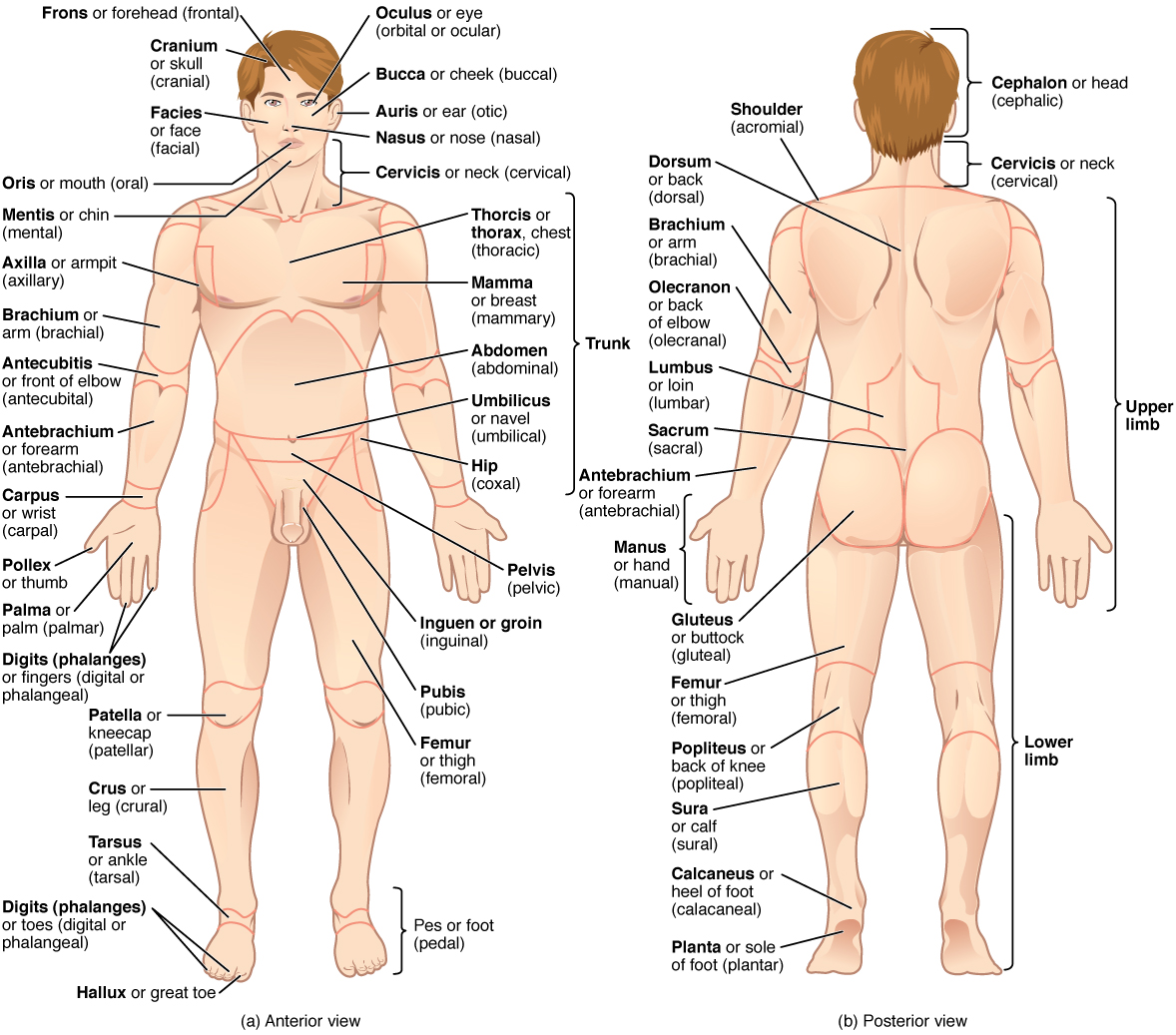 Enlarge illustration ↗
Compare the front and back of the same body. Find the shoulder, elbow and knee in each view; a regional name identifies an area, not one isolated organ.
Image source and licence
Connexions / OpenStax · Source image · CC BY 4.0. Original image, reproduced without alteration.
Head, feet, front and back
Start with two pairs. Superior means towards the head; inferior means towards the feet. Anterior means towards the front of the body; posterior means towards the back. For the trunk, ventral and dorsal are alternative terms for anterior and posterior. These directions follow the body’s reference position, not gravity or the observer. A person lying on their back still has a chest anterior to their spine.
For example: The nose is superior to the mouth. The breastbone is anterior to the spine; the spine is posterior to the breastbone.
Use the face to orient yourself. The arrows show directions, not movement. The body stays in its reference position.
Try it: Is the breastbone anterior or posterior to the spine?
Reveal answer
Anterior. The breastbone is towards the front; the spine is towards the back. This remains true when the person lies down.
Towards and away from the midline
Imagine a line down the centre of the body dividing right from left. Medial means nearer this midline; lateral means farther from it. These words compare structures rather than naming the patient’s right or left. Both shoulders are lateral to the breastbone. Intermediate describes a structure between a more medial and a more lateral structure.
For example: The little finger is medial to the thumb in anatomical position. The middle finger is intermediate between them. Find these relationships on your own hand with the palm facing forward.
Along a limb and beneath the surface
Proximal means nearer a limb’s attachment to the trunk; distal means farther along the limb from that attachment. The elbow is distal to the shoulder but proximal to the wrist. A second pair describes depth: superficial means closer to the body surface and deep means farther from it. Skin is superficial to muscle; muscle is deep to skin. Depth does not mean above or below on the page.
For example: Raising your hand above your head does not make the wrist proximal to the elbow. Its position along the limb is unchanged.
Common misconception: Always give the reference: a structure can be deep to skin but superficial to another structure.
Follow the layers inward from skin through subcutaneous tissue to muscle. Only selected layers are shown.
Try it: Is muscle superficial or deep to the skin?
Reveal answer
Deep to the skin. The skin is superficial to muscle. These are relative positions, not measures of injury severity.
Left and right belong to the patient
In health care, right and left always refer to the patient, never to the person looking. When you face a patient, their right side is on your left. Writing “right arm” without this convention would be dangerous, so the rule is absolute: the patient’s right is the side on which their own right hand lies. The same principle applies to paired structures: the right kidney, the left lung and the right atrium are named from the patient’s point of view. If you are describing an image, say clearly whether it is an anterior or posterior view and whose right side is shown. Precision here prevents the most basic and most serious kind of error in clinical communication.
For example: A patient reports pain in the right lower abdomen. The nurse examines the patient’s own right side, which appears on the nurse’s left when facing them.
Combining terms to describe a precise location
A precise description usually combines several terms and a landmark. Instead of “a cut on the arm”, say “a cut on the anterior surface of the right forearm, midway between the elbow and the wrist”. Each phrase adds information: anterior gives the surface, right gives the side, forearm gives the region, and the midpoint gives the position along the limb. Proximal or distal needs a reference landmark and does not by itself mean “midway”. Clinicians also use planes and regions, which you will meet in later sections, but the directional pairs already allow accurate statements. When you describe a finding, name the side first, then the region, then the surface or depth, and finally the position along the structure. This order becomes a habit that makes your notes unambiguous.
For example: “A 3 cm wound on the posterior aspect of the left leg, just distal to the knee” locates the injury without a picture.
Terms that describe posture and side
Some terms describe the whole body rather than one part. Supine means lying face up, prone means lying face down, and lateral recumbent means lying on one side. Unilateral means affecting one side only, bilateral means both sides, ipsilateral means on the same side as a reference point, and contralateral means on the opposite side. These words are common in notes and handovers, and they save long explanations. For example, “weakness of the right arm with ipsilateral facial droop” places both findings on the same side, which is an important clue during a suspected stroke. As with directional terms, the meaning is fixed and does not depend on the observer’s position, which is exactly why professional communication relies on them.
For example: A patient who cannot move the left arm and has left-sided facial weakness has unilateral left-sided findings; the two signs are ipsilateral to each other.
Schematic side views. Compare the face and the surface against the support. These illustrate posture, not instructions for positioning a patient.
Try it: When lying face up, does the chest become posterior?
Reveal answer
No. Supine describes the posture; anterior still names the front of the body. Turning over changes which surface faces the bed, not the anatomical names.
Key facts to remember
- Anatomical position: standing upright, facing forward, arms at the sides, palms forward, feet flat and pointing forward.
- Superior/inferior, anterior/posterior, medial/lateral, proximal/distal and superficial/deep are opposing pairs along defined axes.
- Proximal and distal describe distance along a limb from its attachment to the trunk.
- Right and left always refer to the patient’s own sides, never the observer’s.
- Supine means face up, prone means face down; ipsilateral is the same side and contralateral the opposite side.
Example · Describe a bruise on the inner side of the right upper arm near the armpit. Inner side of the arm means medial. Near the armpit means proximal, because the armpit is close to where the limb attaches to the trunk. Near the elbow would be distal instead. The complete description is: a bruise on the medial, proximal part of the right arm.
Read full notes
Read one topic at a time. These notes explain the mechanisms and relationships behind the key facts.
Why a fixed reference position matters
Everyday words for location depend on the observer. “Above” means one thing when you stand over a patient and another when you lie beside them. In a clinical record, an ambiguous direction can send a colleague to the wrong place. Anatomical position removes the ambiguity by fixing the body in one posture and defining every directional word relative to it. The convention also allows anatomy to be taught consistently across textbooks, images and languages. When you look at a diagram, the structure marked “left” is the left side of the person in the picture assuming they face you in anatomical position, not the left side of the page. Understanding this convention is the first step toward reading any anatomical image correctly.
The directional pairs along three axes
It helps to group the pairs by the axis they describe. The vertical axis gives superior and inferior. The front-to-back axis gives anterior and posterior. The side-to-side axis gives medial and lateral. A fourth relationship, depth, gives superficial and deep. Proximal and distal are different: they describe position along a limb relative to its attachment, so a single point can be proximal to one landmark and distal to another. Once you know the axes, you can place any structure by combining terms, for example “the medial end of the clavicle, deep to the skin”. Thinking in axes also prepares you for planes and sections, which are simply cuts along these same directions.
Left and right in practice
The rule that left and right belong to the patient is simple but it must become automatic. In a handover, “the wound on the left thigh” means the patient’s left thigh. On an X-ray or scan, use the verified orientation markers. If the side cannot be established, do not guess it from the page layout. When you examine a patient, orient yourself first: which way are they facing, and where is their right hand? Then all directional terms fall into place. Errors of side are among the most serious avoidable mistakes in care, and they are prevented by a habit, not by memory. Saying the side out loud while you confirm it against the patient is a reliable check.
Proximal, distal and the limbs
Proximal and distal are used mainly for the limbs and for tubes that branch, such as blood vessels, nerves and ducts. Along an arm, the shoulder is the most proximal point and the fingers the most distal. Along a leg, the hip is proximal and the toes distal. In the digestive tract, the mouth is proximal and the anus distal, because material moves along the tube. In a blood vessel, blood flows from the proximal part to the distal part of the same artery. Using the words in this way lets a clinician describe a fracture, a blockage or a wound by its position along a structure, which is often more useful than a simple distance in centimetres, because it is meaningful in every body size.
From terms to a clinical picture
Directional language is not decoration; it carries clinical meaning. A pain that is “anterior and medial” in the chest may suggest one structure, while one that is “posterior and lateral” suggests another. A swollen calf that is “unilateral” points to a local cause, while “bilateral” swelling suggests a body-wide problem such as heart or kidney involvement. Weakness on one side of the body compared with the other is often recorded as ipsilateral or contralateral to a lesion. Because these words encode relationships, a change in wording can change the whole interpretation. Learning them accurately is therefore part of learning to think clinically, not a separate vocabulary exercise.
Explore the diagram
Start with the whole view, then select a numbered structure. Compare the additional illustrations to connect what a structure looks like with what it does.
A shared reference position
Front view: the subject faces you, palms forward. Right and left belong to the subject.
More controls
01 / 7 Superior
Superior means towards the head. The chest is superior to the pelvis.
Superior
Towards the head. The head is superior to the chest.
Illustration credits
- Goran tek-en · Male front 3d-shaded human illustration.svg · CC BY-SA 4.0.

Adapted for this lesson: labels removed, artwork cropped or recoloured, and interactive teaching overlays added. Adapted artwork retains its source licence.
Connect the illustrations to the key ideas
ANATOMICAL POSITION · the shared starting posture
Upright, facing forward, palms forward and feet forward define every directional term.
DIRECTIONAL AXES · superior–inferior, anterior–posterior, medial–lateral
Each pair describes a relationship along one axis; depth adds superficial and deep.
DESCRIBE A LOCATION · side → region → surface → position along the limb
Combine the terms in that order to locate a finding without a picture.
Core Concepts Defined
- Anatomical position
- The standard reference posture: upright, facing forward, arms at the sides, palms forward, feet forward.
- Supine
- Lying face up.
- Prone
- Lying face down.
- Superior
- Towards the head, or above another structure.
- Inferior
- Towards the feet, or below another structure.
- Anterior (ventral)
- Towards the front of the body.
- Posterior (dorsal)
- Towards the back of the body.
- Medial
- Towards the midline of the body.
- Lateral
- Away from the midline of the body.
- Intermediate
- Between a medial and a lateral structure.
- Proximal
- Nearer the attachment of a limb to the trunk.
- Distal
- Farther from the attachment of a limb to the trunk.
- Superficial
- Closer to the body surface.
- Deep
- Farther from the body surface.
- Ipsilateral
- On the same side of the body as a reference point.
- Contralateral
- On the opposite side of the body from a reference point.
- Bilateral
- Affecting or occurring on both sides.
- Unilateral
- Affecting or occurring on one side only.
Go deeper · worked example
Writing an unambiguous wound description
- Fix the reference. Start from the assumption of anatomical position, so superior, anterior and medial have one meaning regardless of how the patient is lying now.
- Name the side first. Say “right” or “left” and mean the patient’s own side. If the patient is facing you, their right is on your left.
- Name the region, then the surface. Give the body region, such as forearm, then the surface: anterior or posterior, medial or lateral.
- Give the position along the limb. Use proximal or distal, or a clear landmark such as “midway between elbow and wrist”.
- Check the sentence against the rules. Confirm that side, region, surface and position along the limb are all present and that no term depends on the observer’s viewpoint.
Explain it yourself · Write, in your own words, a description of a cut on the back of the left lower leg just above the ankle.
Reveal a model explanation
The cut is on the posterior aspect of the left leg, in the distal part, immediately proximal to the ankle. “Posterior” gives the surface, “left” the side, “leg” the region, and “distal” plus the ankle landmark give the position along the limb. No phrase refers to the observer, so the description works from any direction.
Check
Answer three questions from this section — one easy, one medium and one hard. If you miss one, you get a fresh set with explanations for the last attempt.
Practise this sectionOpen all questions and filter by difficulty or Bloom levelReferences and review status
OpenStax, Anatomy and Physiology 2e, 1.6 Anatomical Terminology; Tortora & Derrickson, Principles of Anatomy and Physiology, 12e, ch. 1. Author review only; medical and French-language expert review pending.
Optional further reading · English · internet required:
- Anatomy and physiology: an overview
- Structural organisation of the body
- Homeostasis and feedback
- Anatomical terminology
Original teaching schematics. English and French wording is author-reviewed for study; anatomy and French-language expert review is pending. Checks are practice only, not a graded examination.
Practice progress is saved on this device for the current learner.