BMS 114 · Common Core (Tronc commun)Section 1.4 · The microbial world
Section 4 of 33
How microorganisms cause harm
Explain why only a very small minority of microorganisms are pathogens, name the protozoa, fungi and viruses that harm people, and distinguish food spoilage from food that is genuinely unsafe.
New to this course? How each section works
Learn gives you one short idea at a time. Each idea starts with a single sentence, then explains it, gives an example, and asks you a small question you can answer straight away.
Explore shows a diagram of the same ideas. Click the numbered parts to read what each one is.
Check asks a few questions. Answer them all correctly to finish the section and unlock the next one.
“Go deeper” is optional. It adds mechanism and extra detail for when you are ready — nothing you need for the checks is hidden there.
Why this matters
Some microbes cause disease, spoil food or produce harmful toxins; many others do not. The practical task is to understand the agent, host and route of exposure. Food can be unsafe without looking spoiled, and a microbe’s presence alone does not establish the cause of illness.
What you need to know first
You should be comfortable with the definition of a microorganism and with the idea that microorganisms are not all alike. Section 1.2 named the major groups; this section looks at the harm a few of them do and at what happens when they grow in food. Three words to hold on to are pathogen, commensal and toxin.
Words to know (6)
Pathogen
A microorganism able to cause disease in a susceptible host. Only a very small minority of microorganisms are pathogens; the rest are harmless or useful to people. Plasmodium species are pathogens; the bacteria of the normal gut flora usually are not.
Colonisation
The presence and multiplication of a microorganism at a body site without signs or symptoms of disease at that site. Colonisation is not the same as infection. Streptococcus pneumoniae can colonise a healthy child’s nose and throat without causing any illness.
Opportunistic pathogen
A microorganism that usually lives harmlessly in or on the body but causes disease when the host’s defences fall, when it reaches a normally sterile site or when a medical device is present. Candida albicans overgrows after broad-spectrum antibiotics and can invade the bloodstream.
Spoilage
The microbial breakdown of food that changes its colour, texture or odour and makes it unfit for human consumption. Spoilage is a change in the food, not automatically an infection in the person who eats it. Milk that turns sour and bread that grows a green mould are spoiled.
Foodborne intoxication
Illness caused by a toxin that microorganisms have already produced in the food before it is eaten. The poison acts without the organism having to grow inside the patient. Violent vomiting three hours after a creamy dish that stood warm points to a preformed toxin.
Vector
A living carrier, usually an insect or another arthropod, that transmits an infectious agent from one host to another. Controlling the vector protects a whole community. The female Anopheles mosquito is the vector of malaria; the tsetse fly transmits sleeping sickness.
One idea at a timeIdea 1 / 5
In one sentence Microbial effects depend on the organism, the host and the setting; microbes are not automatically pathogens.
Many microbes are useful; some cause disease
Many microbes recycle nutrients, support ecosystems or live in a healthy microbiota. Some can cause disease when they reach a susceptible host or an inappropriate body site. There is no single fixed percentage that describes this across all microbial groups and settings.
The supplied notes wrongly associate most microorganisms with deliberate biological misuse. A small set of agents can be misused, but that does not define the microbial world. In nursing, focus on identifying exposure, symptoms and appropriate precautions rather than assuming that every organism is harmful.
For example
An organism recovered from a skin swab may be a resident microbe, whereas the same organism in a suitable deep specimen with compatible symptoms may support an infection diagnosis. Sample context changes interpretation.
Pause and check yourself
A patient has read that most microorganisms are used as weapons. How should the nurse correct this?
Show the answer
Explain that the opposite is true: the overwhelming majority of microorganisms are harmless or useful, only a very small minority cause disease, and bioterrorism would deliberately use a handful of agents such as anthrax or smallpox — never “most microbes”.
Read detailed explanations
Spoilage organisms and food-poisoning organisms are not the same
Spoilage and illness are different outcomes of microbial activity. Decomposition may release odorous compounds, gas or coloured growth. Some spoilage organisms are not typical causes of illness, while some moulds produce mycotoxins. A visible change is a reason for appropriate disposal, but normal appearance is not evidence that a food is safe.
Foodborne intoxication follows exposure to toxin already formed in food. Staphylococcal enterotoxins and the emetic toxin of Bacillus cereus can cause rapid vomiting, often within hours. Not every toxin behaves identically: botulism has a different clinical pattern, and other hazards have different onset times. Infection follows ingestion of an organism that establishes itself in the host. Salmonella symptoms commonly begin from six hours to six days; Campylobacter usually from two to five days. These intervals guide investigation, but overlap prevents diagnosis by the clock alone.
Heating kills many organisms, yet some toxins are heat-stable and some spores survive ordinary cooking. Refrigeration slows many microbes rather than sterilising food; Listeria can grow at refrigeration temperatures. Avoid trying to rescue a suspect dish by reheating. Prevention combines clean handling, separation of raw and cooked items, thorough cooking, suitable holding temperature and safe water. Food-safety instructions vary with product and local policy, and retained outbreak samples should be handled according to public-health advice.
The same organism, harmless here and dangerous there
Microbial harm depends on strain, site and host defences. Colonisation means presence without disease at that site; opportunistic infection can occur when circumstances change. Some E. coli strains are normal colon inhabitants, while particular strains or movement to another site can cause illness. Bladder infection is assessed from symptoms and appropriate tests, not from a universal assumption that all urine is microbe-free. The organism need not change species to have a different effect.
Staphylococcus epidermidis lives harmlessly on skin and becomes one of the commonest causes of bloodstream infection when it forms a biofilm on an intravenous catheter or a prosthetic heart valve. Streptococcus pneumoniae is carried in the nasopharynx of many healthy children, yet causes otitis media, pneumonia and meningitis when it spreads to the middle ear, the lung or the meninges. Candida albicans is a normal resident of the mouth, gut and vagina; broad-spectrum antibiotics remove the bacteria that usually restrain it, and in a patient with neutropenia or a long intensive-care stay it can invade the bloodstream. Clostridioides difficile behaves in the same way: the organism may be present without symptoms, and disease appears when antibiotics disturb the gut flora and the bacterium produces its toxins.
Four mechanisms explain these changes of role: a barrier is breached, as with a wound, a catheter or surgery; the organism translocates from its normal site to a sterile one; the host defences fall; or a device gives the organism a surface on which to build a biofilm. The nurse’s questions about a positive culture are always the same: what site was sampled, does the patient have signs of infection at that site, what device is in place, and what has changed in the patient’s defences? A positive swab from a chronic ulcer is not automatically an infection, and treating it with antibiotics because the laboratory reported a name is one of the commonest errors in ward practice. Hand hygiene, careful device care, aseptic technique and the prudent use of antibiotics are the interventions that keep a colonising organism in its place.
How these organisms actually reach people
Transmission explains which preventive action can interrupt exposure. Malaria is usually spread by infected female Anopheles mosquitoes; ordinary contact does not spread it, although rare blood-related or congenital transmission occurs. Bed nets and other locally indicated vector-control measures reduce exposure. Sleeping sickness is spread mainly by tsetse flies. The gambiense form is generally slower than rhodesiense, but both progress from an early stage to central nervous system involvement; neurological disease is not automatically present from the start. Toxoplasmosis may follow ingestion of tissue cysts in undercooked meat or oocysts from contaminated soil or water, and infection can cross the placenta.
Histoplasmosis is not contagious between people: its spores are inhaled from soil enriched with bird or bat droppings, for example while cleaning a chicken coop or exploring a cave, and the illness is usually mild, though it can disseminate in an immunocompromised patient. Ringworm spreads by direct skin contact and by shared combs, towels, mats and shoes, so an outbreak in a school or barracks is controlled by treating cases and cleaning shared objects, not by isolating one child. Candidiasis is mostly endogenous: it comes from the patient’s own flora when antibiotics, diabetes, steroids or a damaged immune system remove the usual restraint.
Influenza spreads in respiratory droplets and on hands, and its surface antigens drift from season to season, so last year’s immunity may not protect; vaccination must be repeated and offered to health workers as well as patients. Yellow fever is transmitted by Aedes mosquitoes, particularly Aedes aegypti, which breed in domestic water containers and bite by day; a safe vaccine remains the mainstay of control. HIV is transmitted sexually, through infected blood and needles, and from mother to child in pregnancy, birth or breastfeeding; it destroys CD4 T lymphocytes over years, so the nurse follows the CD4 count and viral load and anticipates the opportunistic infections that appear as the count falls. Reducing transmission is therefore always specific: a net for malaria, gloves and a safe water supply for toxoplasmosis, a vaccine for yellow fever, sterile needles and never recapping for HIV, and ventilation with a mask for influenza.
Explore the diagram
Look at the whole drawing first. Then select one numbered part and connect it to the idea you just read.
Recognise differences in organisation
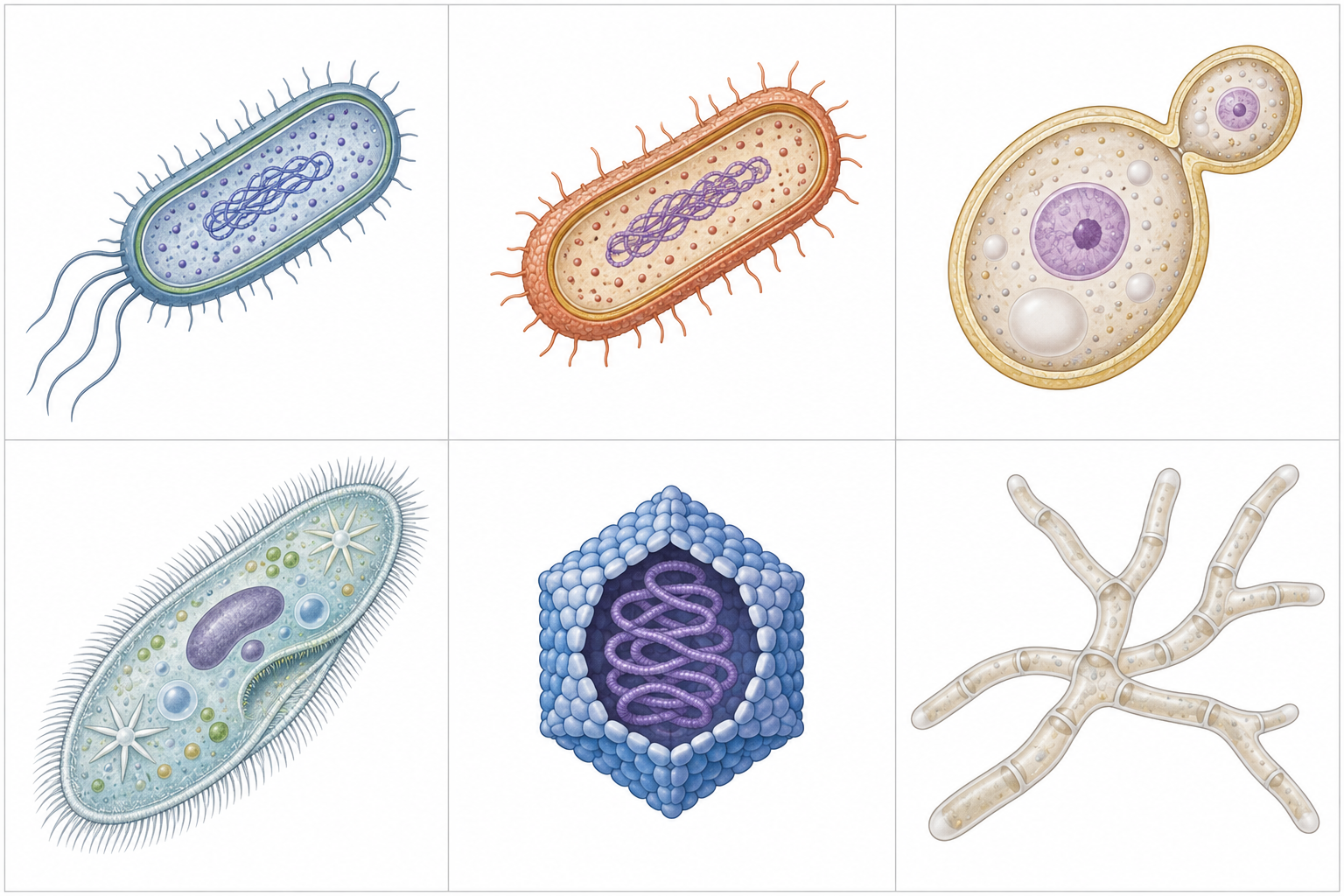
Choose an image and connect its structure to the explanation. AI-generated schematics with no common scale; these are not micrographs or diagnostic images.
Virus particle
The outer protein capsid surrounds a genome. There is no nucleus, cytoplasm or ribosome: this is an acellular particle. It needs a host cell to make new particles. Other viruses have a lipid envelope or a different shape; antibacterial drugs do not treat viral replication.
Original image and limitations
Sizes, colours and details are simplified for conceptual comparison. The archaeal outline is not an identification criterion. Labels and explanations use your selected language.
Follow the same starting condition down two branches. On the left, the organisms change colour, texture and odour, which is the spoilage the notes describe. On the right, nothing changes and the danger is a pathogen or a preformed toxin. Each branch ends in the nursing action that follows from it.
New to diagrams? Read this first
Look at the whole drawing once without clicking anything. Ask yourself only: what kind of picture is this (a comparison, a route, a sequence, a table)?
Press Play, or use the arrows, to move through the numbered parts in order. The drawing stays still; only the highlight moves.
Click a number, or its name in the list below, to read what that part is and why it matters. Use “Hide labels” when you want to test your memory.
More controls
01 / 6The starting condition
If the drawing is wider than this panel, scroll it sideways. Labels stay readable; the numbered explanations below show the same ideas.
The starting condition
This is the condition that decides everything downstream, not the food itself. Cooked food that stays between 5 °C and 60 °C for more than two hours gives bacteria the warmth, water and nutrients they need, whether or not the dish is refrigerated afterwards.
Decision aid for cooked food kept in the warm zone, not a scale drawing of any kitchen. The two branches are extremes used to separate spoilage from hazard; a single dish can carry both, and the temperature range and the two-hour limit are standard food-safety guidance rather than values taken from the supplied notes.
Key points to remember
✓Many microbes are useful or harmless in their usual setting; disease depends on the agent, host and exposure.
✓Protozoa cause malaria, sleeping sickness and toxoplasmosis; fungi cause ringworm, candidiasis and histoplasmosis; influenza, yellow fever and AIDS are viral.
✓Bacteria and fungi spoil food by growing in it and changing its colour, texture and odour, which makes it unfit to eat.
✓Spoilage changes food; foodborne illness harms the eater. Infection and intoxication have varying and overlapping onset times.
✓Appearance is not a safety test: judge food by time in the warm zone, cooking and handling, and remember that the same organism can be harmless in one site and dangerous in another.
Go deeper
Worked example
Four vomits, three hours, one rice dish. You are the nurse on duty at a health centre on a Saturday evening. Six people attended a funeral meal; four of them now have vomiting, abdominal cramps and diarrhoea that began about three hours after eating. The meal included rice and a creamy salad that stood on a table in a warm room for several hours. Nobody noticed anything wrong with the food, and the leftovers are still at home.
Use timing as a clue, not proof. Vomiting about three hours after a shared meal is compatible with some preformed toxins. Other causes remain possible. Salmonella illness commonly begins between six hours and six days after exposure; Campylobacter usually takes two to five days. Assess the full pattern and investigate the cluster.
Care for the patients first. Assess dehydration: pulse, blood pressure, skin turgor, urine output and the ability to drink. Give oral rehydration solution in small, frequent sips, record the losses, and watch the very young and the elderly most closely. Do not give antidiarrhoeal drugs on your own initiative; follow the prescriber and local guidance.
Collect the evidence, including the food. Send stool and vomit specimens as the laboratory protocol requires, and arrange for the leftover food to be kept refrigerated and sent for testing rather than thrown away. Notify the public health team, because a single household cluster may be the first sign of a food business serving many people.
Prevent further exposure. WHO guidance recommends not leaving cooked food at room temperature for more than two hours, refrigerating promptly below 5 °C, or keeping it hot above 60 °C before serving. Follow local guidance if stricter. Safe water, separation, thorough cooking and clean handling also matter: time and temperature alone do not guarantee safety.
The visible test most people use — colour, texture and smell — answers a different question from the one that matters. The nurse works from exposure, timing, temperature, specimens and notification, and that chain is what stops the next outbreak.
Common misconception
Normal appearance does not prove food safety: pathogens or toxins can be present without obvious spoilage. Onset time is a clue, not proof of an agent. Microbes are not automatically harmful, and a positive sample does not by itself prove infection; site, strain, host and collection quality all affect interpretation.
Check your reasoning
Think of a meal you have seen handled carelessly — at home, at a market or in a hospital kitchen. Which of the four steps in the worked example would have caught the problem, and which one would have prevented it?
Reveal an answer
Take a hospital kitchen where a tray of cooked chicken is left at room temperature for three hours before service. Recognising the timing would catch it during an investigation, because the warm three hours are exactly the period in which a pathogen can grow or a toxin can form; the preventive step is the two-hour rule, refrigeration below five degrees and separation of raw from cooked food. Notice the pattern: detection looks backwards at what happened, while prevention changes what happens next, and the same knowledge of temperature and time drives both.
Where this comes from
BMS 114 General Microbiology I lecture notes (supplied) · “Harmful” effects of microorganisms and food spoilage, lines 304–318
Correction to the supplied notes — the share of microorganisms that are pathogens · Correction to the supplied notes: lines 305–306 claim that “a greater majority of them are used in bioterrorism and biological welfare”. Only a very small minority of microorganisms are pathogens, and bioterrorism deliberately uses a handful of chosen agents such as Bacillus anthracis and variola virus. “Biological welfare” is not a recognised term; the notes appear to mean biological warfare or biosecurity.
Beyond the supplied notes — vectors, toxins and incubation periods · the vectors (Anopheles, Glossina, Aedes), the site-dependence of infection (Escherichia coli, Staphylococcus epidermidis, Candida albicans, Clostridioides difficile), the toxin-producing foodborne agents (Staphylococcus aureus, Clostridium botulinum, Bacillus cereus, Aspergillus flavus) and their incubation ranges follow standard medical microbiology; the notes at lines 307–309 and 315–317 name the diseases and the fact of spoilage without mechanism, vector or timing.
Lesson progress is saved on this device for the current learner. Practice answers stay separate and are not stored.
About this course and its sources
Bilingual lessons organised from the supplied BMS 114 General Microbiology I lecture notes (Mr Ngotelo F. Ambene, Mr Lyonga B. Lyonga & Mr Fumbui Louis Ngong). Diagrams are original educational schematics; sections that correct the notes or go beyond them say so in their sources. Nursing and French-language review are pending.