In one sentence Saprophytes are microorganisms that decompose dead remains and waste, returning the nutrients they contain to the environment.
Saprophytes recycle the dead matter of every ecosystem
Every ecosystem produces a continuous supply of dead material: fallen leaves, dead animals, shed skin, dung and food waste. Left untouched, the carbon, nitrogen, phosphorus and sulfur locked inside that material would stay there, and the cycles that supply living things would slowly stop. Saprophytes prevent this.
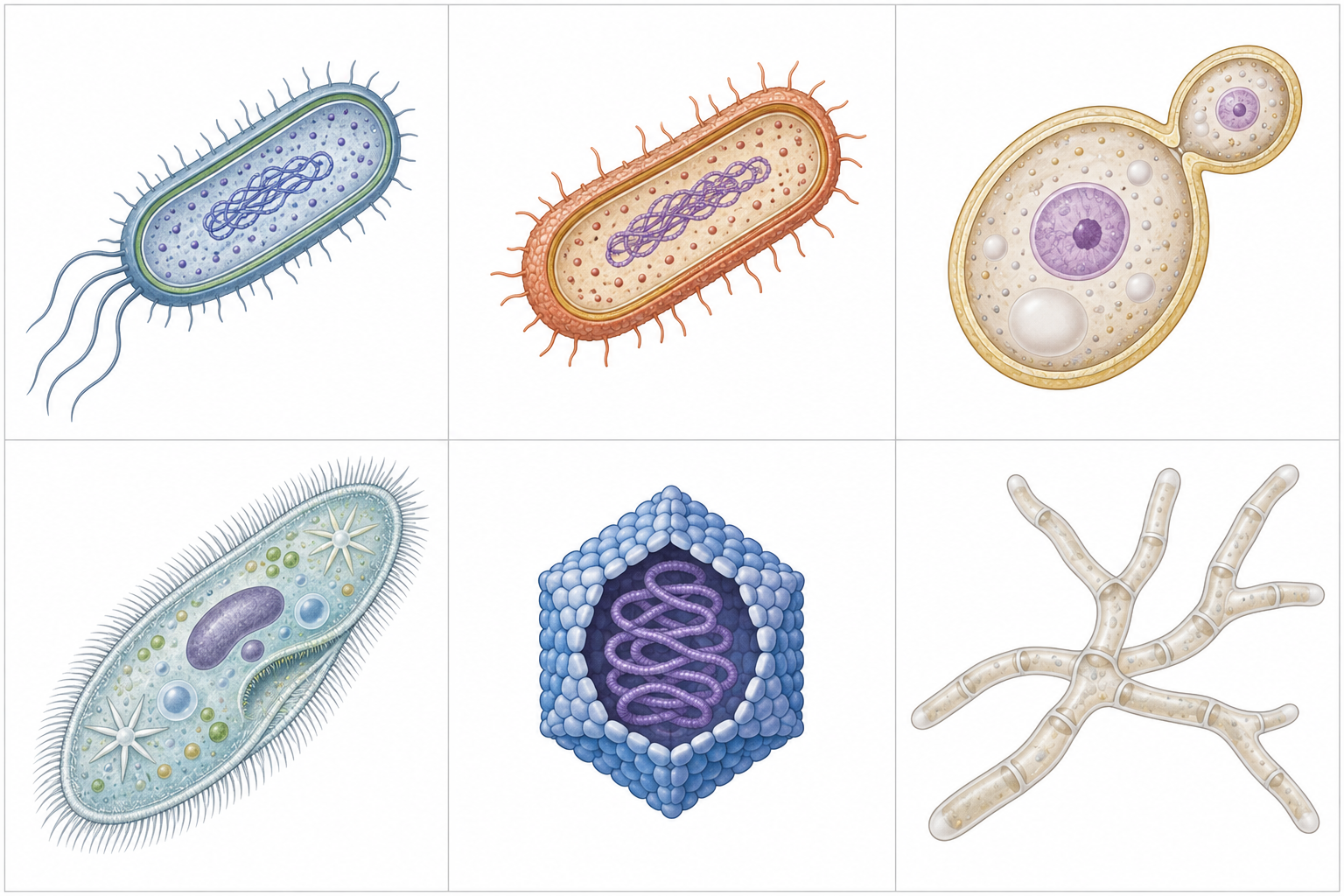
They are microorganisms that feed on dead organic matter, and they do it from the outside in: the hypha of a mould or the wall of a bacterium releases digestive enzymes that break large molecules into small soluble ones, which the cell then absorbs as food. What is left over — carbon dioxide, ammonium, nitrate, phosphate and sulfate — is released into the soil, water and air as the microbe’s waste.
That waste is exactly what plants need, so decomposition turns death into raw material for new growth. The same process, run under control, is what composting, sewage treatment and the safe disposal of dead tissue all rely upon.
A leaf that falls in a forest is attacked by fungi and bacteria; its cellulose and proteins are digested away over weeks, and the minerals released at the end of that digestion feed the roots of the next tree. Nothing is wasted.
Why is a compost heap warm and why does its volume fall over several weeks?
Show the answer
The saprophytes are digesting the waste and releasing heat as they work, and they are converting solid plant material into carbon dioxide, water and soluble minerals, so much of the original mass leaves the heap as gas and liquid.
Read detailed explanations
- Nitrogen fixation: the enzyme, the oxygen problem and the trade
Nitrogenase converts atmospheric N₂ into ammonia using electrons and energy from ATP hydrolysis. ATP supplies energy, not the electrons themselves. Oxygen can damage the enzyme, so nitrogen-fixing microbes use protective arrangements rather than simply needing a universally oxygen-free environment. Free-living organisms as well as plant symbionts can fix nitrogen; some separate fixation in space or time.
Inside legume nodules, rhizobia differentiate into bacteroids. The nodule supplies carbon compounds from the plant. Leghaemoglobin helps maintain low free oxygen while allowing respiration, balancing the need for energy with enzyme protection. Ammonia is assimilated into nitrogen-containing compounds shared through the partnership. If soil nitrogen is readily available, the plant may invest less in this costly process.
The partner depends on the host species and bacterial strain. Nodulation is not guaranteed simply because a plant is a legume, and water, acidity and available nutrients affect performance. Non-legumes can also form nitrogen-fixing associations, such as alder with Frankia. This diversity shows why a root nodule is one example of a wider biological process, not the only location where nitrogen fixation occurs. Nitrogen supplied to a crop still needs to be balanced with its other growth requirements.
- Colonisation resistance: why the flora is a barrier, and what antibiotics break
Colonisation resistance combines several mechanisms rather than forming an impenetrable barrier. Resident microbes occupy niches, compete for nutrients and change local chemistry. Some produce bacteriocins that inhibit related bacteria; fermentation products can lower pH, and interactions with immune cells influence local defences. The effect varies by site and community. A resident organism may still become harmful if a barrier is breached or host defences fall.
Antibiotics can alter abundance and diversity without removing every resident. The degree of disruption depends on the drug, dose, duration and starting community. C. difficile spores may persist while competing bacteria are suppressed; toxin-producing strains can then contribute to diarrhoea. Diarrhoea has other causes too, and detecting the organism without compatible illness is not automatically a diagnosis. Contact precautions, indicated testing and effective environmental cleaning follow local guidance.
The community also supplies metabolites. Fermentation of fibre produces short-chain fatty acids such as butyrate that support colon lining cells. Some bacteria produce menaquinones, forms of vitamin K, while diet also contributes vitamin K. Prolonged antibiotics combined with poor intake may impair status; platelet disease, liver function and interacting medicines must also be considered when bleeding occurs. Probiotics are not a universal remedy for a disturbed community and require a separate assessment of evidence and patient risk.
- Microbial factories: fermentation, antibiotics, recombinant proteins and bioremediation
What a microbe does in a test tube it can be made to do in a vessel of thousands of litres; industrial microbiology is the control of that scale-up. Fermentation first distinguishes two routes. In alcoholic fermentation, yeasts such as Saccharomyces cerevisiae convert one glucose molecule into two of ethanol and two of carbon dioxide; this gives bread its gas and beer and wine their alcohol. In predominantly homolactic food cultures, sugar is converted mainly to lactic acid rather than gas, which is why yogurt does not swell but yeasted dough does. Cheese-making layers these: rennet or acid coagulates casein, the curd is drained and salted to control the flora, and ripening with Penicillium roqueforti, Penicillium camemberti or Propionibacterium shermanii produces blue veins, white rind or Emmental’s holes.
Antibiotic production is another branch of the same industry. Most antibiotics are secondary metabolites, substances the organism does not need for growth and makes after rapid growth; penicillin, produced by Penicillium chrysogenum rather than the Penicillium notatum Fleming saw in 1928, is made this way, as is streptomycin from Streptomyces griseus. Industrial strains are improved by mutation and selection until they yield thousands of times more than the wild isolate, and the fermenter controls temperature, pH, oxygen, sterility and foam while the product is harvested and purified.
Recombinant DNA moved the industry into medicines microbes have no reason to make. In 1982 human insulin became the first genetically engineered medicine approved clinically: its gene was inserted into Escherichia coli, which read the human instructions and made the hormone. Recombinant production uses suitable cells for each protein: microbes make some products, while mammalian cell cultures are needed for others, including many complex glycoproteins.
Bioremediation borrows the opposite trick — the appetite of some bacteria for hydrocarbons — but it has firm limits. The organisms need nitrogen, phosphorus, a suitable temperature and, usually, oxygen, so oil on cold, oxygen-poor water or buried in mud breaks down very slowly, and the process cannot remove every fraction of a spill. Genetically modified bacteria are studied for bioremediation, but their release is regulated because organisms spread, so a clean-up combines mechanical recovery, dispersants and natural microbial action rather than bacteria alone. For the nurse, the practical thread is prudent antibiotic use: because most antibiotics are bacterial products that resistance can defeat, teaching patients to follow the current prescription and seek advice about changes and never to share leftovers or demand them for a viral illness is industrial microbiology at the bedside.