BMS 114 · Common Core (Tronc commun)Section 1.1 · The microbial world
Section 1 of 33
What microbiology is, and why health personnel study it
Explain what microbiology studies, name its main branches, and give three ways microbiology changes what a nurse does for a patient.
New to this course? How each section works
Learn gives you one short idea at a time. Each idea starts with a single sentence, then explains it, gives an example, and asks you a small question you can answer straight away.
Explore shows a diagram of the same ideas. Click the numbered parts to read what each one is.
Check asks a few questions. Answer them all correctly to finish the section and unlock the next one.
“Go deeper” is optional. It adds mechanism and extra detail for when you are ready — nothing you need for the checks is hidden there.
Why this matters
Microbiology explains how microbes live, how some cause infection, and how many help us. At the bedside it supports specimen collection, safe use of medicines and prevention of transmission. Begin with the difference between a living cell, a virus and a disease-causing agent.
What you need to know first
You need only ordinary school science and your own experience of illness. Three words are used constantly and are defined below: microorganism, pathogen and sterile. Nothing else is assumed. The next section introduces the five groups of microorganisms one at a time.
Words to know (5)
Microbiology
The study of microscopic organisms and acellular agents such as viruses, including their structure, activities, classification and effects. Identifying the bacterium in a wound swab is microbiology.
Microorganism
An organism too small to be seen clearly without magnification. The broader word microbe is also commonly used for acellular viruses. A bacterium or yeast is a cellular microbe; a virus is an acellular agent, not a tiny living cell.
Pathogen
A microorganism that is able to cause disease in a susceptible host. Mycobacterium tuberculosis is a pathogen; the bacteria of the gut flora usually are not.
Normal flora (microbiota)
The community of microorganisms that lives on and inside a healthy body without normally causing disease. Gut bacteria that make vitamin K are normal flora.
Sterile
Completely free from all living microorganisms, including bacterial endospores — the dormant, heat-resistant forms some bacteria make — and from viruses. An intact pack is accepted as sterile only after a validated sterilisation cycle and storage; boiling alone is not reliable sterilisation.
One idea at a timeIdea 1 / 4
In one sentence Microbiology studies microscopic organisms and acellular agents such as viruses, including useful microbes and pathogens.
Microbiology studies microbes and their activities
Bacteria and yeasts are living cells. Viruses are acellular: they have genetic material but depend on a host cell to make new virus particles. Microbiology studies both, without calling a virus a tiny bacterium.
Its scope also includes larger fungi and parasitic worms because microscopic stages help explain their life cycles and diagnosis. This science studies structure, growth, relationships and practical effects: a wound infection, yogurt fermentation and antibiotic production are all examples.
For example
A laboratory receives a swab from a discharging surgical wound. Microbiology is what turns that swab into a name, a susceptibility pattern and a treatment decision.
Pause and check yourself
A patient asks why a tapeworm, which can be seen with the eye, is studied in microbiology. What is the best answer?
Show the answer
Medical parasitology studies the whole worm life cycle. Microscopic eggs or larvae often help diagnosis; adult worms may also be identified. Worms do not all form cysts, and not every stage is found in stool.
Read detailed explanations
The five questions microbiology answers, and how long each one takes
Laboratory results answer different questions and arrive at different times. A Gram stain can give an early clue about bacterial shape and staining reaction once the sample is processed. A result within an hour is possible, but transport, opening hours and specimen type affect turnaround. Some organisms are not visible or are not reliably classified by this stain.
Culture attempts to grow living organisms under selected conditions. Many routine bacterial cultures give early growth in one or two days, while slow-growing organisms take longer. Identification may use culture, biochemical methods or direct molecular tests; culture is not the only way to identify a species. Susceptibility testing usually needs an isolate and additional processing, although rapid methods also exist.
These timings explain why urgent care cannot wait for a complete report. The clinical team starts empirical treatment from the likely source, severity and local resistance patterns, then reassesses when results arrive. Specimens are ideally collected first if that causes no significant delay. Monitoring and prevention begin immediately and continue alongside testing: they are not final steps that must wait for a laboratory sequence. Repeat cultures are requested for particular indications, rather than routinely for every infection.
How to read a microbiology report without over-reading it
A report must be interpreted with the specimen and the patient. White blood cells suggest inflammation but do not prove that a particular microbe is causing it. A surface swab may include normal skin organisms; an organism in a specimen can represent contamination, colonisation or infection. The collection site and technique determine how much weight the result deserves.
No growth can follow antibiotic exposure, low numbers, unsuitable sampling or growth conditions, and does not exclude infection. A positive result also does not automatically require treatment. Clinical findings and sample quality must support that interpretation. Molecular tests can detect genetic material even when viable organisms are not recovered; that answers a different question from growth in culture.
Susceptibility categories depend on the reporting standard. Under EUCAST, S means susceptible with standard exposure, I means susceptible with increased exposure, and R means resistant. Some other systems use I for intermediate. Increased exposure may involve a clinician-adjusted dosing regimen or a concentration achieved at the infection site; nurses should follow the local laboratory legend and prescription rather than treating every I as resistance. No category guarantees cure: source control, drug delivery, host factors and adherence also matter. Escalate conflicting results or clinical deterioration for review instead of changing treatment independently.
The microbiology nurses perform with their own hands
Prevention is continuous, not something that starts after a positive culture. Hand hygiene is performed before patient contact, before an aseptic task, after body-fluid exposure risk, after patient contact and after touching the patient’s surroundings. Gloves do not replace it. Standard precautions apply regardless of whether an infection has been diagnosed; additional precautions depend on the route of transmission.
Cleaning removes soil and must precede appropriate reprocessing. Antiseptics are intended for living tissue; disinfectants are used for suitable inanimate surfaces. Boiling and antiseptics are not reliable instrument sterilisation. Critical devices entering normally sterile tissue or the vascular system require a validated sterilisation process. Semicritical devices contacting intact mucous membranes generally require at least high-level disinfection, with sterilisation where appropriate and according to manufacturer instructions. Single-use devices follow their specified use and local policy.
Sharps go directly into a suitable container; routine recapping increases injury risk. Specimens need the correct container, identifiers, volume and transport conditions. These are practical ways to protect staff and preserve diagnostic information. Patient education supports prescribed antibiotic use, vaccination and cough hygiene. Patients should follow the current prescription and seek advice about adverse effects or changed instructions, rather than sharing leftover antibiotics or extending treatment on their own.
Explore the diagram
Look at the whole drawing first. Then select one numbered part and connect it to the idea you just read.
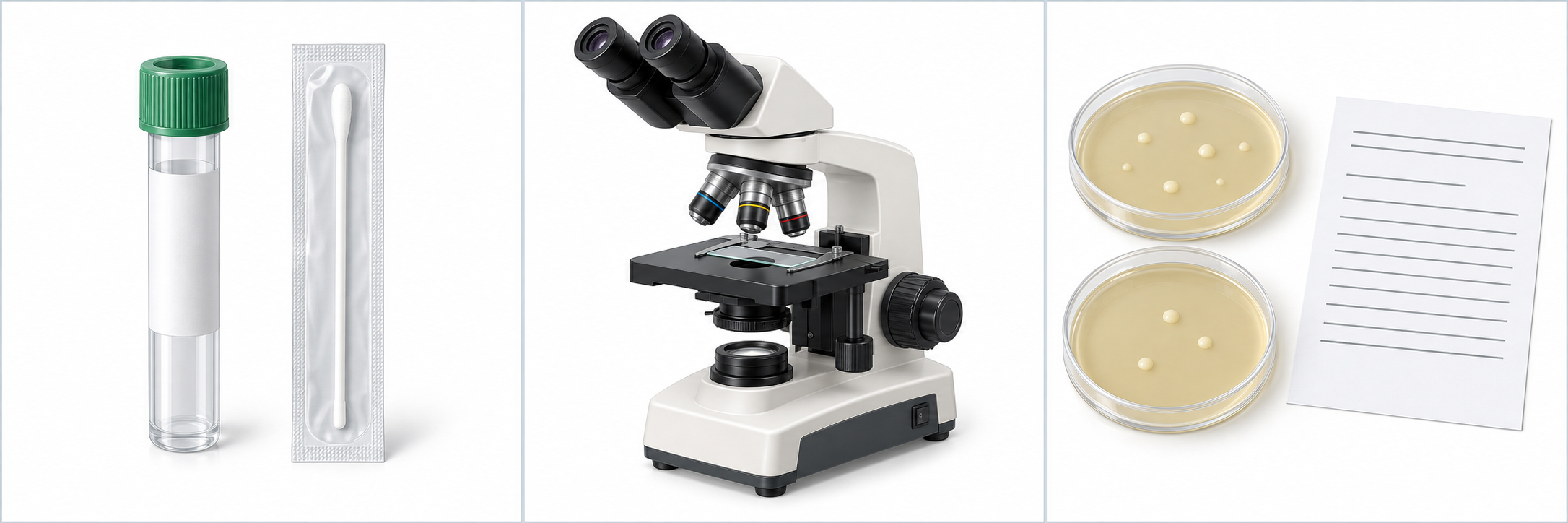
From specimen to result
Choose an image and connect its structure to the explanation. AI-generated schematics with no common scale; these are not micrographs or diagnostic images.
Collect a specimen
The container protects the sample; its label connects it to the patient and collection site. The correct container, volume and transport depend on the test. Collect before antibiotics when feasible, without delaying urgent treatment. The drawing is equipment orientation, not a sampling procedure.
Original image and limitations
Sizes, colours and details are simplified for conceptual comparison. The archaeal outline is not an identification criterion. Labels and explanations use your selected language.
From specimen to prevention: what microbiology answers, and how long it takes
Follow a typical culture-based investigation. Collection, microscopy and culture contribute different evidence; monitoring and prevention run alongside the laboratory work. Urgent treatment must not wait for a completed chain.
New to diagrams? Read this first
Look at the whole drawing once without clicking anything. Ask yourself only: what kind of picture is this (a comparison, a route, a sequence, a table)?
Press Play, or use the arrows, to move through the numbered parts in order. The drawing stays still; only the highlight moves.
Click a number, or its name in the list below, to read what that part is and why it matters. Use “Hide labels” when you want to test your memory.
More controls
01 / 6Specimen: the nurse’s first decision
If the drawing is wider than this panel, scroll it sideways. Labels stay readable; the numbered explanations below show the same ideas.
Specimen: the nurse’s first decision
Everything downstream depends on this step. The sample must come from the right site, be taken with sterile technique, be placed in the correct container and be sent promptly. If it is taken after antibiotics have reached the patient, the organism may no longer grow but useful results can still be obtained; do not delay urgent treatment.
A schematic, not a time scale or mandatory order. Times are illustrative and vary. Prevention and monitoring begin immediately; urgent treatment must not await laboratory results. Critical devices require validated sterilisation; devices touching intact mucosa generally require at least high-level disinfection.
Key points to remember
✓Microbiology studies microscopic organisms and acellular agents such as viruses, including useful microbes and pathogens.
✓It is divided into branches — bacteriology, virology, mycology, parasitology, protozoology, helminthology and immunology — which overlap in one patient.
✓Knowing how a germ is transmitted is what protects the health worker and the patient, and it decides which precautions are used.
✓Microbiology structures the nursing routine from specimen collection to monitoring therapy and vaccination.
Go deeper
Worked example
From a discharging wound to a treatment plan. Five days after abdominal surgery, a patient has a warm, red wound that is discharging thick yellow pus and a temperature of 38.6 °C. You are the nurse caring for the patient on the ward round. You must decide what microbiology is needed, when to collect it, and what each result will allow the team to do.
Recognise the problem as infectious. A wound that is warm, red, painful and discharging pus, with fever, points to a multiplying organism in the tissue. Microbiology enters the plan at the point where you must know which organism it is and what will kill it.
Collect as prescribed using the local sampling protocol. A deep tissue or pus specimen may be more informative than a surface swab, and appropriately trained staff obtain it. Record patient identifiers, site and collection time, and send promptly. Collect before antibiotics when feasible, without delaying urgent treatment.
Use early findings as clues, not a prescription. A Gram stain may show bacterial shape and staining, but does not determine the species or susceptibility. The prescriber combines the patient’s condition, likely source, allergies and local guidance when starting empirical treatment; serious infection is treated without waiting for the stain or final culture.
Act on the full result and keep monitoring. When the culture identifies the organism and the susceptibility report lists which drugs work, the team narrows or changes the antibiotic. Your role continues: give the drug on time, watch the wound and the temperature, and report failure to improve rather than waiting for the next review.
The sequence — recognise, collect correctly, act on the early result, refine on the full result — is the same for a wound, a urine sample or a blood culture. Microbiology is not an errand you send to the laboratory; it is a chain in which the nurse controls the first and the last links.
Common misconception
Microbiology is more than a laboratory errand: specimen quality, communication, timely medicines and monitoring link laboratory work to bedside care. Finding a microbe does not by itself prove infection, and a negative culture does not exclude it. Wound care may involve drainage, dressings and antibiotics depending on assessment; every wound does not automatically need a systemic antibiotic.
Check your reasoning
Think of an infection you have seen or read about. Which branch of microbiology would study it, which specimen would confirm it, and which one nursing action would have prevented it?
Reveal an answer
Take postoperative wound infection. Bacteriology studies it; a deep wound swab or aspirate of fresh pus sent before antibiotics confirms it; and consistent hand hygiene, correct surgical asepsis and proper wound dressing technique are the nursing actions that most often prevent it. Notice that all three answers come from the same body of knowledge — the organism, the sample and the preventive action are linked by how the germ reaches the wound.
Where this comes from
BMS 114 General Microbiology I lecture notes (supplied) · “General introduction to microbiology” and “Importance and relevance of microbiology to health personnels”, lines 159–223
Correction to the supplied notes — sterilisation by boiling · Correction to the supplied notes: lines 176–177 state that hot water or antiseptics sterilise instruments. Boiling and chemical antiseptics disinfect but do not reliably destroy bacterial endospores; items that breach skin or mucosa require validated sterilisation (WHO and CDC guidance on decontamination and sterilisation).
Beyond the supplied notes — diagnostic timings and specimen quality · the times to Gram stain, culture, identification and susceptibility results, and the effect of collecting a specimen after antibiotics, follow standard diagnostic microbiology practice; the notes name the tests at lines 181–183 without giving the sequence or its timing.
Correction to the supplied notes — inclusive language for patients and nurses · Correction to the supplied notes: lines 173–205 use “he/his” for patients and nurses. Author inclusive language (“the patient”, “their samples”, “nurses and other health personnel”), which this section applies in its wording.
Lesson progress is saved on this device for the current learner. Practice answers stay separate and are not stored.
About this course and its sources
Bilingual lessons organised from the supplied BMS 114 General Microbiology I lecture notes (Mr Ngotelo F. Ambene, Mr Lyonga B. Lyonga & Mr Fumbui Louis Ngong). Diagrams are original educational schematics; sections that correct the notes or go beyond them say so in their sources. Nursing and French-language review are pending.